
AI Hiring Security in 2026: Why Authenticity Matters More Than Ever
The biggest threat in hiring today isn’t a lack of talent.
It’s the rise of fake candidates.
In 2026, recruitment has entered a new phase. Companies are no longer just competing to attract top talent they are struggling to verify whether the talent is real.
With the rise of AI‑generated resumes, deepfake interviews, and proxy candidates, hiring teams are facing a serious challenge: candidate authenticity. What used to be rare is now scaling rapidly, especially in remote and global hiring environments.
A resume that looks perfect might be generated by AI.
An interview that feels smooth might be assisted in real time.
A candidate who performs well might not even be the person you hire.
This is where AI‑powered candidate verification and fraud detection in recruitment are becoming critical before the first interview even begins.
The Growing Problem of Fake Candidates in Recruitment
Today, hiring teams feel overwhelmed not just by volume but by validity.
Modern recruitment faces:
- AI‑generated resumes optimized for ATS systems
- Fake work experience and certifications
- Multiple candidates controlled by a single operator
- Deepfake video interviews and voice manipulation
- Proxy candidates attending interviews on behalf of others
These are not isolated cases anymore.
They are becoming part of everyday hiring pipelines.
Remote hiring amplifies the problem because it limits physical verification and leads to people assuming trust too early in the process.
Traditional recruitment methods were designed to identify the best candidates.
They were not designed to detect fraudulent ones.
Why Conventional Screening Techniques Are Weak
Manual resume screening and traditional ATS tools rely heavily on keywords, qualifications, and experience.
But fake candidates are built to pass these filters.
A well‑crafted AI resume can:
- Match job descriptions perfectly
- Include realistic career paths
- Pass automated screening systems
- Appear indistinguishable from genuine profiles
Even interviews are no longer reliable.
Candidates can use:
- Real‑time AI assistance for answers
- Pre‑trained scripts
- Proxy interviewers
- Deepfake video tools
This creates a major gap in hiring:
By the time a recruiter identifies a fake candidate, valuable time and resources have already been lost.
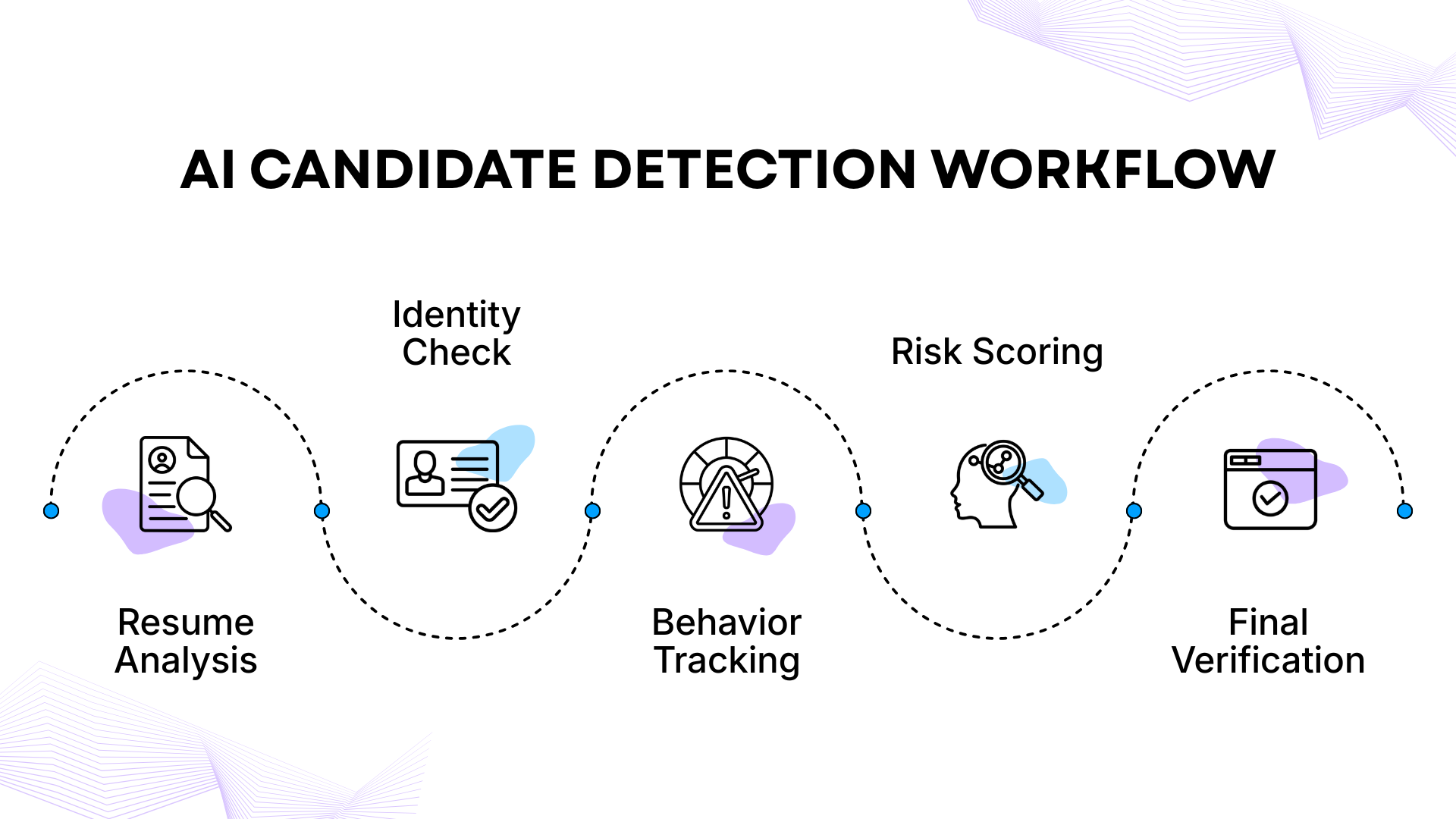
How AI Detects Fake Candidates Before Interviews
AI‑powered hiring systems are shifting the focus from what candidates say to how they behave.
Instead of just analysing resumes, AI analyses behavioural intelligence and data patterns.
Modern AI systems detect fake candidates by evaluating:
- Typing speed and behavioral patterns
- Response timing and consistency
- Resume‑data mismatches across platforms
- IP address and geographic inconsistencies
- Communication style and interaction signals
The system creates a digital behaviour profile for each candidate.
If something feels off even slightly, AI flags it immediately.
Platforms like Talent31 integrate AI resume screening, candidate matching, and fraud detection into a unified system, helping companies identify suspicious profiles before interviews begin.
Deepfake Interviews and AI Counter‑Detection
One of the most advanced threats in recruitment is the use of deepfake technology.
Candidates can now:
- Alter facial appearance during video calls
- Clone voices in real time
- Use AI tools to generate instant responses
These techniques are becoming increasingly difficult for humans to detect.
AI, however, detects subtle signals such as:
- Facial micro‑expression inconsistencies
- Audio‑video synchronization delays
- Voice modulation irregularities
- Behavioral anomalies during interaction
AI does not rely on what is visible at surface level.
It analyses patterns beneath it.
This allows organisations to detect fraud before candidates move to advanced stages.
From Resume Screening to Risk Intelligence
Hiring is evolving from a filtering process into a risk evaluation system.
AI assigns authenticity scores to candidates based on:
- Data consistency
- Behavioral patterns
- Identity verification signals
This creates a trust layer in recruitment.
Instead of assuming every applicant is genuine, companies can:
- Prioritize verified candidates
- Eliminate high‑risk profiles early
- Improve hiring accuracy
- Reduce dependency on manual checks
With Talent31, organisations can combine talent intelligence and fraud detection, ensuring both quality and authenticity in their hiring decisions.
Real‑World Impact: Why Companies Are Adopting AI Detection
Organisations using AI for fake candidate detection are already seeing measurable improvements.
They are:
- Reducing fake candidate entry into pipelines
- Saving recruiter hours spent on invalid profiles
- Improving time‑to‑hire
- Preventing costly hiring mistakes
- Protecting internal systems and sensitive data
Hiring a fake candidate is more than just a hiring error.
It can lead to:
- Security vulnerabilities
- Data breaches
- Financial loss
- Damage to company reputation
In high‑stakes roles, especially in tech and finance, this risk is even higher.
Why This Matters More in 2026
AI is becoming more accessible.
But so is its misuse.
As tools improve, fake candidates will become:
- More sophisticated
- Harder to detect manually
- More frequent in hiring pipelines
Companies that rely only on traditional hiring methods will face:
- Increased hiring risk
- Slower decision‑making
- Reduced hiring quality
Meanwhile, companies using AI‑powered hiring systems will:
- Detect fraud early
- Hire faster and safer
- Build stronger, more reliable teams
The gap between these two approaches is widening quickly.
Talent31: Building Trust‑First Hiring Systems
Talent31 is built for the modern hiring environment where speed and authenticity must go together.
It combines:
- AI resume screening
- Candidate matching intelligence
- Behavioral fraud detection
- Workforce planning insights
Instead of reacting to fake candidates after interviews, Talent31 helps companies prevent them from entering the pipeline in the first place.
This transforms hiring from:
- Reactive → Proactive
- Risk‑prone → Secure
- Manual → Intelligent
The Future of Hiring: Trust Before Talent
Finding the best applicant is no longer the only aspect of hiring.
It is about ensuring the candidate is real, verified, and trustworthy.
AI is not just improving hiring efficiency.
It is protecting the integrity of recruitment systems.
In 2026, companies that succeed in hiring will not be the fastest.
They will be the ones that combine:
- Speed
- Intelligence
- Verification
Because in today’s hiring environment:
A great candidate is valuable.
But a real candidate is essential.
FAQs
How does AI detect fake candidates before interviews?
AI analyses behavioural patterns, data inconsistencies, and identity signals, such as typing behaviour, response timing, and location mismatches, to identify fake candidates early.
What are fake candidates in recruitment?
Fake candidates are individuals using AI‑generated resumes, deepfake interviews, or proxies to manipulate hiring processes.
What is deepfake interview fraud?
Deepfake interview fraud involves using AI to alter video or audio during interviews to impersonate another person or enhance responses.
Why is fake candidate detection important in 2026?
With remote hiring and AI tools becoming widespread, detecting fake candidates is essential to prevent hiring risks, fraud, and security issues.
How does Talent31 help detect fake candidates?
Talent31 uses AI‑powered candidate verification, fraud detection, and talent intelligence to identify suspicious candidates before interviews.