
Hiring Has a New Problem and Most Companies Haven’t Noticed Yet
The biggest hiring risk in 2026 isn’t a talent shortage.
It’s a talent and deception.
Imagine spending weeks sourcing, screening, and interviewing a candidate who seems perfect on paper and performs flawlessly in interviews only to discover later that the person you hired isn’t the person who showed up during the process.
This is not a rare scenario anymore. It’s becoming a pattern.
AI interview fraud is quietly reshaping recruitment. Candidates are now using advanced tools to manipulate hiring systems, pass interviews, and secure roles they are not qualified for. And most hiring teams don’t even realise it’s happening until it’s too late.
This is not just a hiring inefficiency. It’s a trust crisis in recruitment.
What AI Interview Fraud Actually Looks Like in 2026
AI interview fraud is not limited to fake resumes anymore. It has evolved into something far more sophisticated.
Candidates are now using:
- Real‑time AI answer generators during interviews
- Voice cloning tools to sound more confident or experienced
- Deepfake video overlays to impersonate someone else
- Proxy candidates to attend technical interviews
- AI‑assisted coding tools to solve problems instantly
The result is a candidate who appears highly skilled, confident, and aligned with the role but only during the interview stage.
Once hired, the gap becomes visible.
Performance drops. Communication breaks. Deliverables slow down.
By then, the cost has already been incurred.
Why Traditional Hiring Systems Are Failing
Most hiring systems were designed for a different era when fraud was manual, rare, and easier to detect.
Today, AI‑generated deception is
- Scalable
- Realistic
- Hard to detect manually
Recruiters rely on resumes, interviews, and intuition. But these signals are now being manipulated.
A candidate can:
- Use AI to generate perfect answers
- Get real‑time help during interviews
- Mask identity through digital tools
This creates a dangerous illusion of competence.
And here’s the real problem:
Hiring systems are still evaluating performance.
They are not verifying authenticity.
The Real Cost of AI Interview Fraud
Companies often underestimate the impact of hiring the wrong candidate.
But AI interview fraud amplifies this risk.
It leads to:
- Loss of productivity
- Increased onboarding costs
- Delayed project timelines
- Team disruption
- Security risks
In some cases, especially in tech and finance roles, it can lead to data breaches and compliance issues.
While companies are focused on hiring faster, they are unknowingly increasing their exposure to risk.
How AI Is Being Used to Detect AI Fraud
The same technology being used to cheat hiring systems is now being used to protect them.
Modern hiring platforms are shifting from performance evaluation to behaviour analysis.
Instead of asking:
"Did the candidate answer correctly?”
AI asks:
“Did the candidate behave authentically?”
This shift is critical.
Platforms like Talent31 integrate AI‑powered hiring security solutions that analyse patterns beyond human perception.
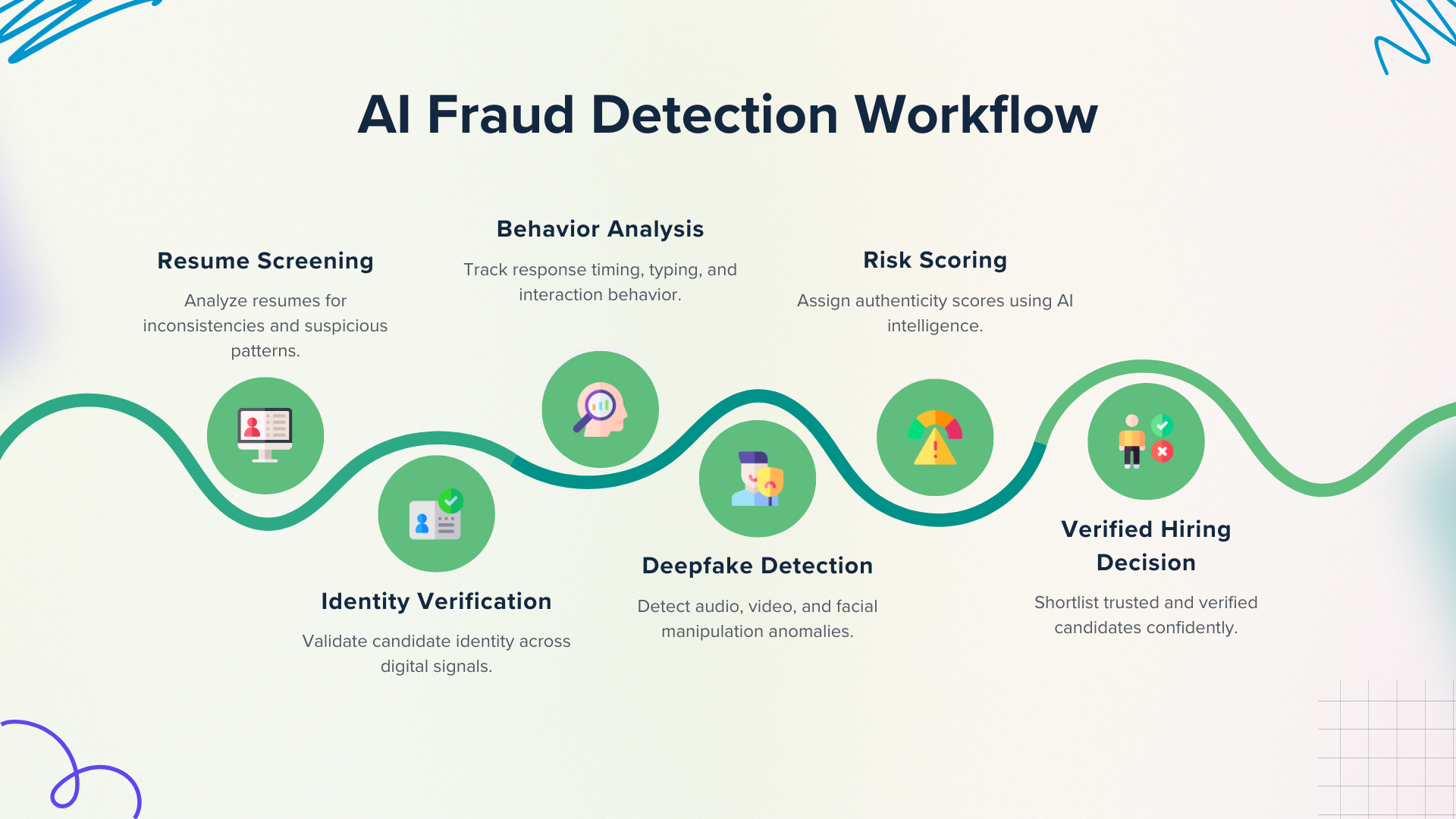
These systems evaluate:
- Response timing consistency
- Typing patterns
- Audio and video synchronisation
- Behavioral anomalies during interaction
- Cross‑platform data consistency
This creates a digital authenticity layer in recruitment.
Deepfake Interviews and Behavioural Signals
One of the most concerning developments is the rise in deep‑fake interviews.
Candidates can now alter their appearance, voice, and responses in real time.
To the human eye, everything looks normal.
But AI detects subtle inconsistencies such as
- Micro‑expression delays
- Audio lag mismatches
- Facial movement irregularities
- unnatural response timing
These signals are nearly impossible to identify manually.
But AI systems can flag them instantly.
This allows recruiters to identify suspicious candidates before they reach the final stages.
From Hiring Process to Fraud Detection System
Recruitment is no longer just a process.
It is becoming a fraud detection system.
Modern hiring workflows now include
- Identity verification
- Behavioural analysis
- Risk scoring
- Data validation
This transforms hiring into a secure and intelligent system.
With tools like Talent31, companies can combine candidate matching with fraud detection in recruitment, ensuring both quality and authenticity.
Real‑World Comparison: Traditional vs AI‑Protected Hiring
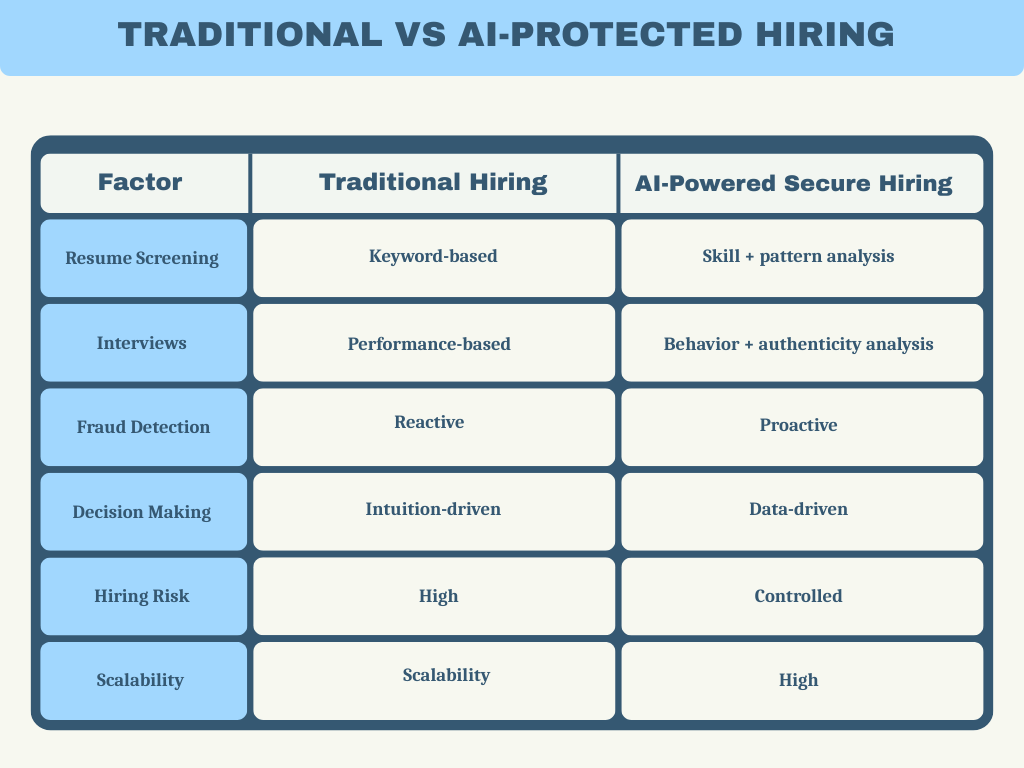
This shift is not optional anymore.
It is becoming necessary.
Why This Problem Will Only Grow
AI tools are becoming more accessible.
What was once advanced is now available to anyone with an internet connection.
This means:
- More candidates will use AI assistance.
- Fraud techniques will become more advanced.
- Detection will become harder without AI.
Companies that ignore this shift will face
- Slower hiring cycles
- Increased hiring failures
- Higher operational risks
Meanwhile, companies adopting AI‑powered hiring systems will:
- Detect fraud early
- Hire faster and smarter
Build stronger teams
Talent31: Securing the Future of Hiring
Talent31 is built for this exact challenge.
It goes beyond traditional hiring tools by integrating
- AI resume screening
- Candidate intelligence
- Behavioral fraud detection
- Predictive hiring insights
This allows companies to move from
- Blind trust → Verified hiring
- Manual screening → Intelligent evaluation
- Risk‑prone hiring → Secure recruitment
Instead of reacting to fraud, Talent31 helps companies prevent it before it happens.
The New Reality of Hiring
Finding talent is no longer the only factor in hiring.
It’s about verifying it.
AI interview fraud is not a future problem.
It is already here.
And the companies that are adapting now will have a clear advantage.
Because in 2026:
The best candidate is not the one who performs well in interviews.
It’s the one who is real, capable, and verified.
FAQs
What is AI interview fraud?
AI interview fraud refers to candidates using AI tools like deepfakes, real‑time answer generators, or proxies to manipulate hiring processes.
How do candidates cheat in AI interviews?
Candidates use tools like voice cloning, AI assistants, and proxy interviewers to provide better answers and hide their real capabilities.
How can companies detect AI interview fraud?
Companies can use AI‑powered hiring systems that analyse behavioural patterns, identity signals, and data inconsistencies.
Why is AI fraud increasing in recruitment?
AI tools are becoming more accessible, making it easier for candidates to manipulate hiring systems.
How does Talent31 prevent interview fraud?
Talent31 uses AI‑driven fraud detection, candidate verification, and behavioural analysis to identify suspicious candidates early.