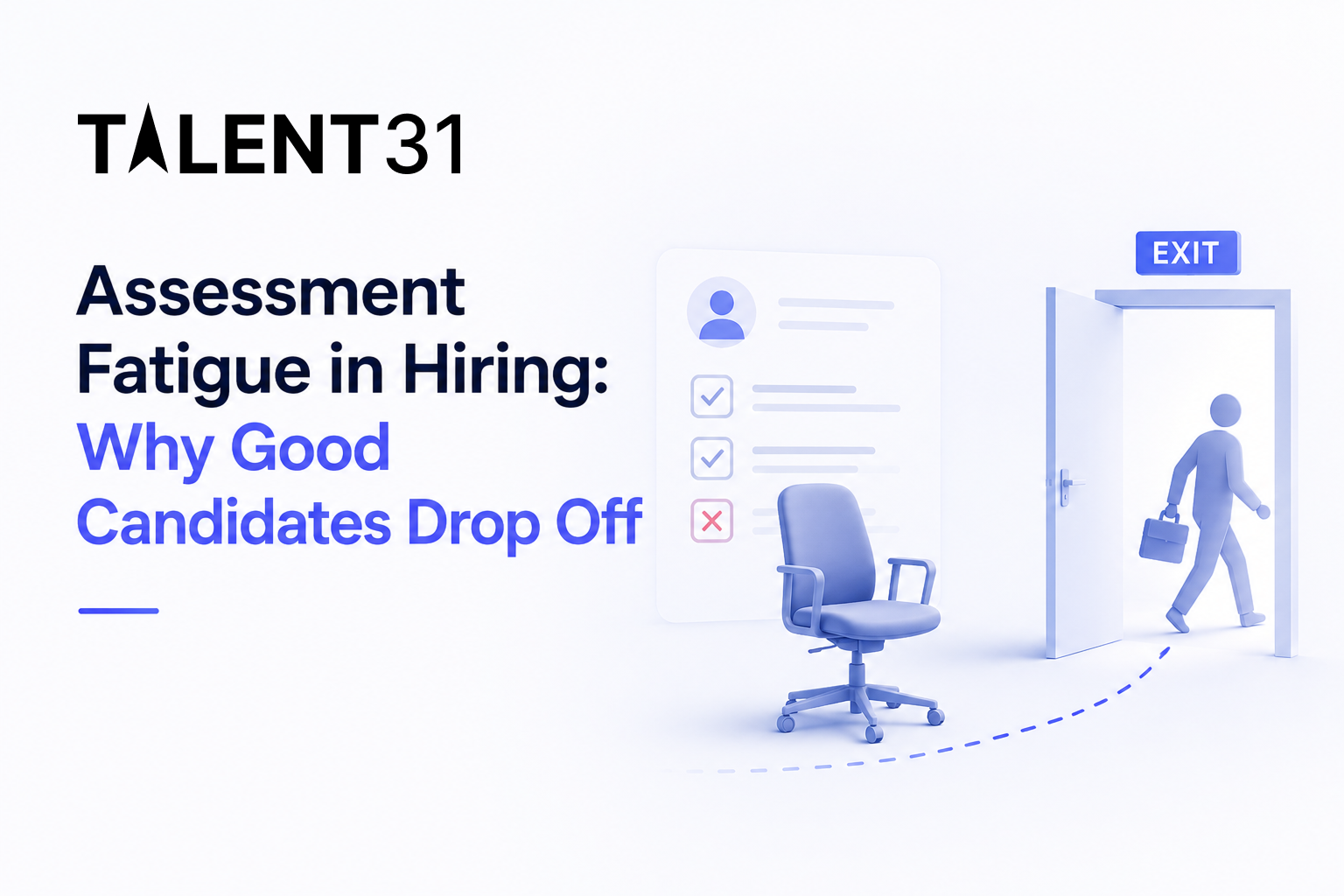
A hiring assessment can be accurate and still be strategically wrong.
That is the part many teams miss. The process may be measuring something real, but it may also be selecting for spare evenings, tolerance for ambiguity, reliable equipment, comfort with surveillance, and willingness to do unpaid work. In technical hiring, that is not a candidate motivation problem. It is a selection system problem.
Think of it like an API with too much latency. The response may be right, but users abandon the request before it returns. An online skill assessment can create the same effect when the burden is high, the purpose is unclear, and the wait between steps keeps growing. Good candidates do not always fail because they cannot do the work. Sometimes they simply route around the friction.
For founders, CTOs, HR leaders, and engineering managers, this matters now because every extra day in the funnel can cost momentum, reputation, and real hiring capacity. The question is not whether assessments can work. They can. The question is whether your process is quietly pushing away the people you most want to hire.
What assessment fatigue really is
Assessment fatigue is the cumulative burden of hiring evaluations when the candidate cannot see a fair trade between the effort asked and the value of continuing.
It has four parts:
- Load: the active work, preparation, setup, waiting, and context switching required
- Relevance: how directly the task measures the job being filled
- Process cost: the number of stages, delays, and handoffs around it
- Perceived return: whether the candidate gets clarity, respect, feedback, and a real chance to move forward
That is why a difficult assessment is not automatically a bad one. A realistic work sample can build trust if it mirrors the job and stays bounded. Fatigue starts when the burden grows faster than the signal.
The practical distinction is simple:
Concept | What it means | Why it matters |
Valid challenge | A task that reflects critical job work | Difficulty can be fair if it is relevant |
Assessment fatigue | Burden that reduces willingness to continue | Withdrawal may reflect process design, not ability |
Technical failure | Device, browser, network, or platform issue | It should never be treated as skill evidence |
Candidate self‑selection | An informed choice to opt out | Sometimes it is healthy and informative |
Adverse impact | Uneven outcomes across groups | Needs review, not assumptions |
The core question is not “Can they finish it?” The core question is “What are we measuring, and which qualified people are we making less likely to finish?”
Why strong candidates are the first to leave
Strong candidates are often the most sensitive to friction.
That may sound backward, but it is consistent with how the market works. A candidate with multiple options has less reason to tolerate slow, repetitive, or opaque steps. They may have a demanding job already, family responsibilities, privacy concerns, or simply enough technical judgment to recognize when an assessment is poorly scoped.
This is where candidate experience becomes a hiring signal. If the process feels disorganized or extractive, better candidates infer something about the company. They are not just judging the test. They are judging how the company will treat engineering time once hired.
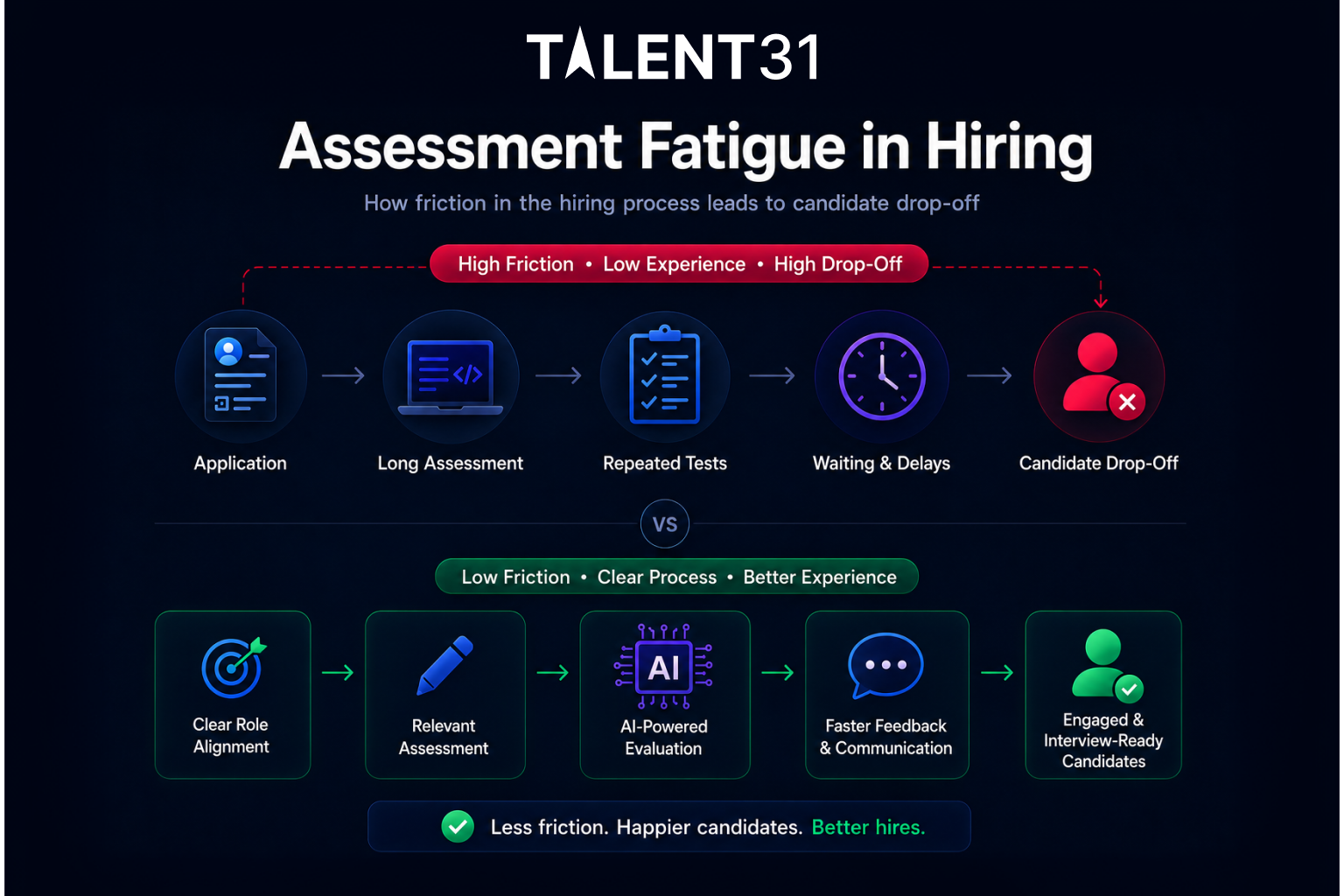
Common friction points include:
- fragmented screening across too many owners
- take‑homes with hidden setup and debugging time
- generic puzzles that do not reflect the role
- long silence after a submission
- repeated tests of the same competency
- proctoring that creates privacy, device, or trust concerns
- unclear failure modes
- no useful closure after effort is invested
That is why assessment fatigue is not just about completion. It is about who stays long enough to be measured.
The biggest reasons good candidates drop off
Here is the pattern I would audit first.
1. The task takes longer than advertised
The real burden is rarely just the timer. Candidates also spend time on setup, instructions, interpretation, testing, packaging, and submission.
When an assignment is described as short but feels long, trust drops fast. Internal pilots should measure both active time and elapsed time, and they should be run by people who resemble the target candidate, not only by the person who wrote the assessment.
2. The work is not clearly tied to the role
A task can be technical and still measure the wrong thing. Generic puzzles, obscure syntax questions, or framework trivia can be easy to score and hard to defend.
An effective online skill assessment should map to a real competency needed at entry to the role. If it cannot be linked back to job performance, it is probably adding burden without much value.
3. The process is slow or repetitive
A candidate can tolerate a fair challenge. What they struggle with is a fair challenge wrapped in weeks of silence and duplicate interviews.
If the resume, recruiter screen, live coding, take‑home, and panel all test the same competency, the later stages become extra drag. The best systems use one assessment to sharpen the decision, not pile on more asks.
4. The process feels one‑sided
Candidates notice when the company learns a lot while revealing very little. If they cannot tell what happens next, who reviews the work, or whether the effort will be acknowledged, the process starts to feel extractive.
That is especially dangerous in technical hiring, where candidates are often asked to contribute significant unpaid effort. If the company expects work that could be reused, the reciprocity question becomes real.
5. Accessibility and monitoring costs are too high
Not every candidate has the same device, bandwidth, room, or tolerance for being recorded. Identity checks and proctoring can be valid controls, but they also create a second hurdle.
A good process uses the least intrusive control that still protects the decision. A bad one creates anxiety and then acts surprised when candidates disappear.
What a fair process looks like
A better assessment is not necessarily shorter. It is clearer, more relevant, and more respectful.
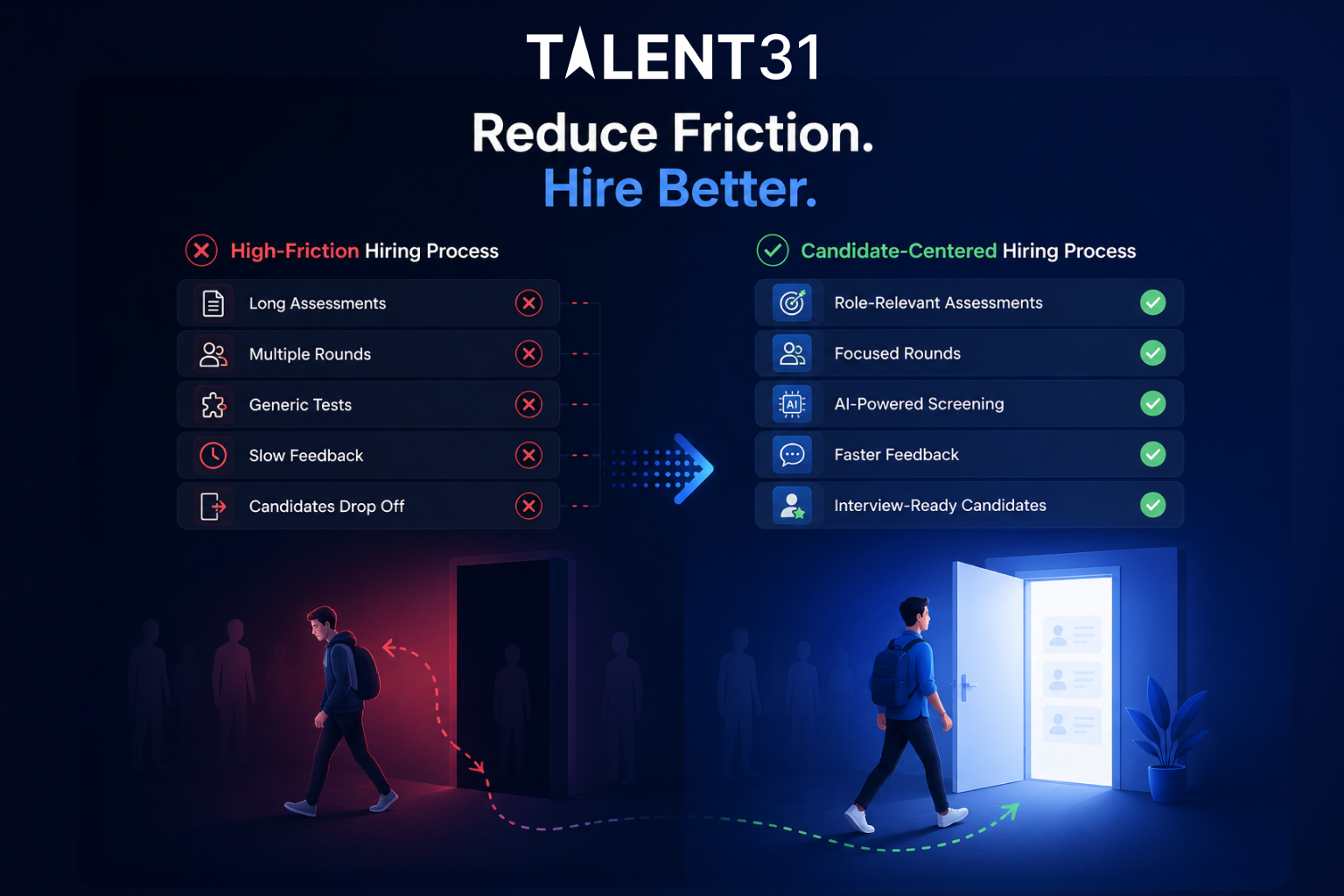
Process dimension | Fatigue‑producing pattern | Candidate‑centered pattern |
Purpose | “Complete this test” with no context | States the role competency and how results will be used |
Scope | Hidden setup and open‑ended polish | Explicit deliverables, exclusions, and expected effort |
Relevance | Generic puzzles or unrelated stack trivia | Work sample tied to real entry‑level demands |
Timing | Short deadline, long silence | Realistic window and clear next‑step date |
Communication | Automated invite, no follow‑up | Named contact, status updates, and respectful closure |
Agency | One mandatory format | A genuine alternative where practical |
Accessibility | Barriers discovered after starting | Accommodation route given before the assessment |
Integrity | Invisible surveillance and automatic rejection | Proportionate controls with human review |
Scoring | Opaque judgment | Job‑linked rubric and trained reviewers |
Reciprocity | Significant unpaid work with no learning | Reasonable burden and credible progression |
This is where Talent31 fits as a teach‑first example. The point is not “more assessment.” The point is less fragmented assessment and a better decision context.
A unified platform can help a team do a few useful things:
- reduce unnecessary invitations through skill‑first matching
- use a role‑relevant assessment instead of a generic test
- centralize status and ownership so candidates are not left waiting
- keep verification and proctoring proportional to the risk
- route ambiguous scores and flags to human review
Used well, that supports better technical hiring. Used badly, it just automates the old mess.
How to measure assessment fatigue internally
Do not optimize for completion alone. A process can become easier and less predictive at the same time.
Track the full flow:
- invitations, starts, partial attempts, submissions, withdrawals
- active assessment time and total elapsed time
- time between stages and time to decision
- technical failures, support requests, and accommodation requests
- candidate‑reported reason for stopping
- assessment result, interview result, offer, hire, and early job evidence
- candidate clarity, fairness, and willingness to recommend
- outcomes by relevant subgroup and location, where privacy and legal review allow
Then compare stated effort with observed effort. That gap is often where trust breaks.
Also look for the deeper pattern: are strong candidates leaving earlier than everyone else? If so, the process may be selecting for availability and compliance instead of capability.
Use cases where the friction shows up
The same problem appears in different forms across hiring motions.
Startup hiring a backend engineer
A founder or CTO may use a work sample to test debugging, API design, or data handling. That can be effective if it is a single, well‑scoped assessment followed by a structured review.
The mistake is adding a second generic coding gate after the work sample already answered the core question.
Global remote technical hiring
Cross‑border hiring adds bandwidth, devices, privacy, and time zone variation. If the process assumes a private room, high‑end equipment, or always‑on proctoring, you will lose candidates for reasons unrelated to skill.
Campus or volume hiring
Automation can handle volume, but it also increases the cost of false rejects. When candidate flow is high, the team needs a validated role‑specific assessment and a clear escalation path for technical failures or ambiguous cases.
Multi‑department hiring
Do not use one generic test for engineering, product, sales, support, and operations. Different roles need different evidence. A common platform is fine. A common rubric for unrelated jobs is not.
The practical takeaway
Assessment fatigue is not a soft people issue. It is an operating issue.
If your process is slow, opaque, repetitive, or overly intrusive, strong candidates will leave. Some will leave quietly. Some will still complete the process but remember it as disrespectful. Either way, the company pays.
The more strategic way to think about this is simple: the best hiring systems maximize decision quality per unit of candidate effort. They explain what they measure, why they measure it, how long it takes, how candidates can succeed, how exceptions are handled, and what happens next.
That is strategic maturity. It shows the same discipline you want in the people you hire.
For an early‑stage company, that matters even more. Respectful, evidence‑linked technical hiring helps preserve scarce engineering time, reduce avoidable rework, and make the employer’s operating culture visible before the offer. Talent31 can support that model when it is used to reduce fragmentation, not add another layer of friction.
FAQ
How long should an online skill assessment be?
There is no universal duration. Set the smallest burden that produces the needed job signal, publish the estimate honestly, and check whether the real effort matches it.
Does dropping out mean the candidate was not strong enough?
No. Drop‑off can reflect unclear scope, delay, competing offers, accessibility barriers, or distrust. Treat it as a process signal first.
Are take‑home assignments always bad?
No. A bounded work sample can be useful. It becomes risky when the scope is unclear, the effort is higher than expected, or the company gives no feedback or closure.
Should technical hiring use remote proctoring?
Only when the integrity risk justifies the burden. Explain what is monitored, use proportionate controls, and send ambiguous flags to human review.
Can AI eliminate assessment fatigue?
No. AI can reduce manual screening, but it cannot decide whether a task is relevant, fair, accessible, or respectful on its own.
What should a team measure besides completion?
Measure active and elapsed effort, technical failures, support requests, candidate clarity, fairness ratings, withdrawal reasons, and later hiring quality.
How can Talent31 help without adding more friction?
By helping teams reduce unnecessary invitations, centralize the workflow, use role‑relevant assessments, and apply verification only where the risk justifies it.