
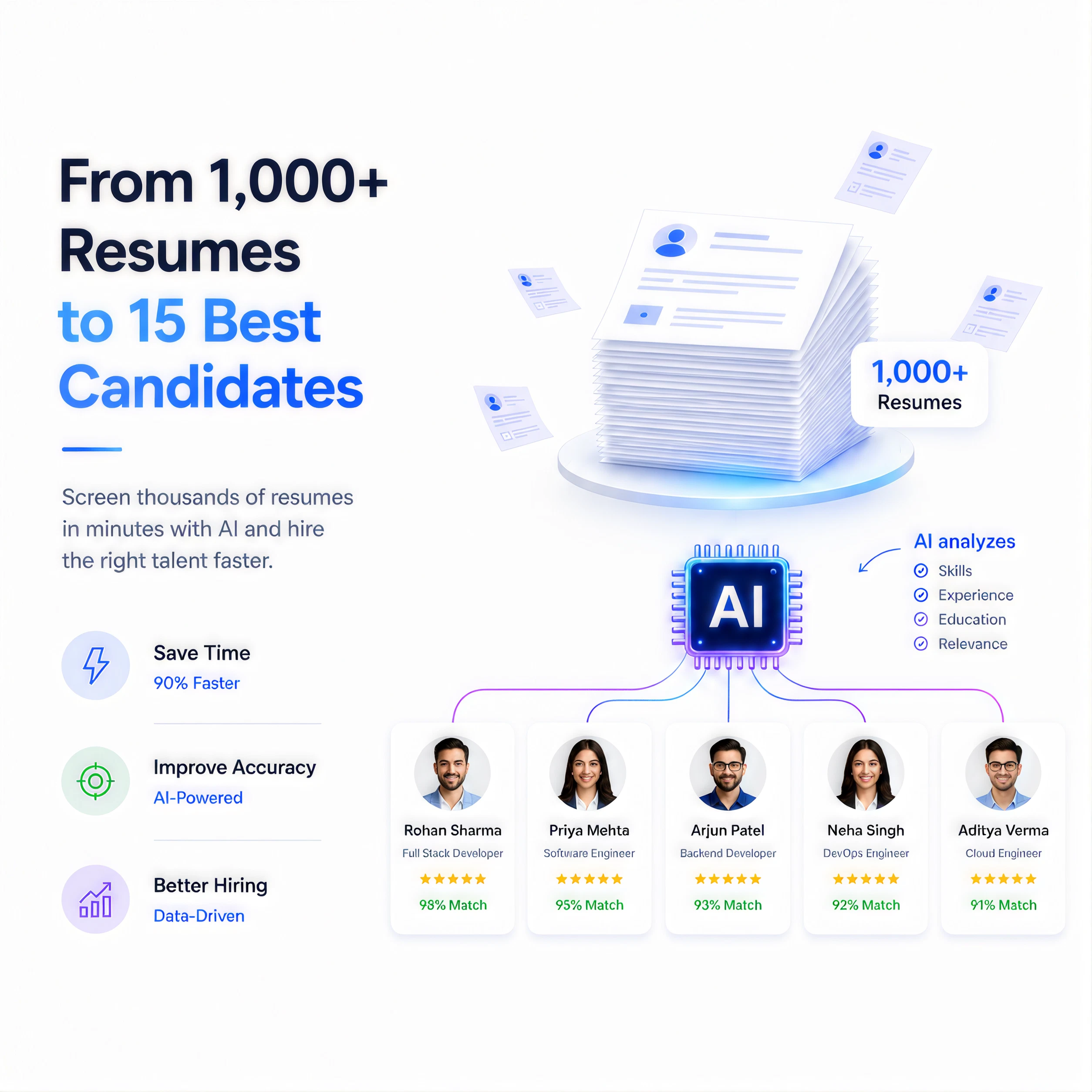
Every Resume Takes Two Minutes. What Happens When You Receive 1,000?
Imagine posting a single job opening on Monday morning. By Tuesday afternoon, your inbox contains more than 1,000 resumes.
Some candidates are highly qualified. Others barely meet the requirements. A few have used AI to tailor their resumes perfectly to the job description. Hidden somewhere in that pile could be your next top performer or someone who simply knows how to optimise keywords better than everyone else.
Now ask yourself one question:
Can any recruiter realistically review 1,000 resumes accurately within a day?
The answer is no.
Recruitment has changed dramatically over the past few years. Companies are receiving more applications than ever before, while recruiters are expected to hire faster, improve candidate quality, and reduce hiring costs simultaneously. Manual resume screening, once considered the backbone of recruitment, is now one of the biggest bottlenecks in the hiring process.
This is exactly why AI resume screening has become one of the fastest-growing technologies in recruitment. Rather than replacing recruiters, artificial intelligence helps them identify qualified candidates in minutes instead of days, allowing hiring teams to focus on interviews, relationship building, and strategic decision-making.
For organisations hiring at scale, AI is no longer a competitive advantage it is becoming a necessity.
The Hidden Cost of Manual Resume Screening
Many companies underestimate how much time resume screening actually consumes.
Suppose a recruiter spends just two minutes reviewing one resume. Screening 1,000 applications would require over 33 hours of uninterrupted work. Recruiters don't only screen resumes. They also coordinate interviews, communicate with candidates, work with hiring managers, and manage multiple open positions simultaneously.
The result is predictable.
Qualified candidates remain waiting for days. Top talent accepts offers from faster-moving competitors. Hiring managers become frustrated by delays, while recruiters feel overwhelmed by repetitive administrative work.
Even worse, manual screening introduces inconsistency.
Different recruiters often evaluate resumes differently. One recruiter may prioritise certifications, while another focuses on years of experience. Important skills can easily be overlooked because they aren't written using expected keywords or resume formats.
In today's hiring landscape, relying entirely on manual resume reviews creates both operational inefficiencies and business risks.
Why Traditional Resume Screening Is No Longer Enough
The recruitment landscape in 2026 looks very different from what it did just a few years ago.
Candidates now use AI tools to improve resume formatting, optimise keywords, rewrite work experience, and align applications with Applicant Tracking Systems (ATS). Some applicants even generate multiple versions of resumes tailored for different roles within minutes.
This creates an interesting challenge.
Recruiters are no longer evaluating only candidates.
They are evaluating how effectively candidates use AI.
Traditional resume screening methods were never designed for this level of complexity.
Reading resumes one by one might have worked when companies received a few dozen applications for each vacancy. Today, enterprise organizations frequently receive hundreds or even thousands of applications within the first 48 hours of publishing a job.
Without automation, hiring quickly becomes impossible.
What Is AI Resume Screening?
AI resume screening is the process of using artificial intelligence to automatically analyse, organise, rank, and prioritise resumes based on predefined hiring criteria.
Instead of simply searching for keywords, modern AI recruitment software examines multiple signals simultaneously.
It evaluates candidate skills, work experience, education, certifications, job relevance, career progression, technical competencies, and contextual information to determine how well each applicant matches a specific role.
Unlike traditional ATS filters, advanced AI systems don't just ask,
"Does this resume contain the required keyword?"
They ask,
"Is this candidate actually qualified for the role?"
This shift from keyword matching to intelligent candidate evaluation is transforming how recruiters identify top talent.
Modern AI-powered hiring platforms like Talent31 combine AI Resume Screening, AI Candidate Matching, and Talent Intelligence to help recruiters shortlist qualified candidates faster while maintaining consistency and accuracy throughout the hiring process.
How AI Screens Thousands of Resumes in Minutes
One of the biggest misconceptions about AI recruitment software is that it simply scans resumes for keywords.
Modern AI works very differently.
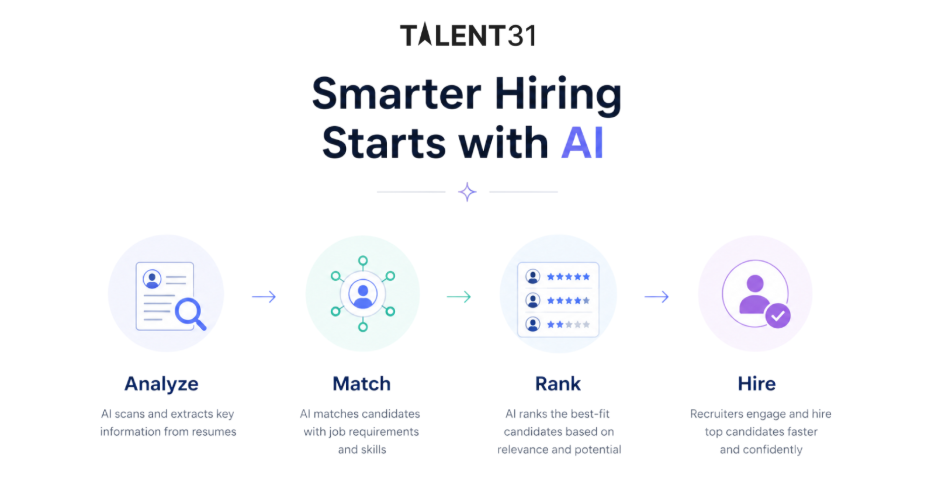
The process begins the moment candidates submit their applications. Instead of manually opening every document, AI automatically extracts structured information from resumes, regardless of their layout or formatting.
The system identifies essential details such as technical skills, certifications, years of experience, education, previous job roles, and industry expertise. It then compares this information against the job description using machine learning models that understand relationships between skills, not just exact keyword matches.
For example, if a job requires cloud engineering expertise, AI can recognise related technologies such as AWS, Azure, Kubernetes, Docker, Terraform, and DevOps practices, even when the exact wording differs from the job description.
This allows recruiters to discover highly qualified candidates who might otherwise be overlooked by traditional screening methods.
Instead of spending hours searching for resumes manually, recruiters receive a ranked shortlist based on candidate relevance, allowing them to move directly into interviews and evaluation.
Manual Resume Screening vs AI Resume Screening
Feature | Manual Screening | AI Resume Screening |
Time Required | Hours or Days | Minutes |
Resume Capacity | Limited | Thousands at once |
Candidate Matching | Manual Review | AI-powered skill matching |
Screening Consistency | Varies by recruiter | Standardized evaluation |
Recruiter Productivity | Low | High |
Hiring Speed | Slow | Significantly Faster |
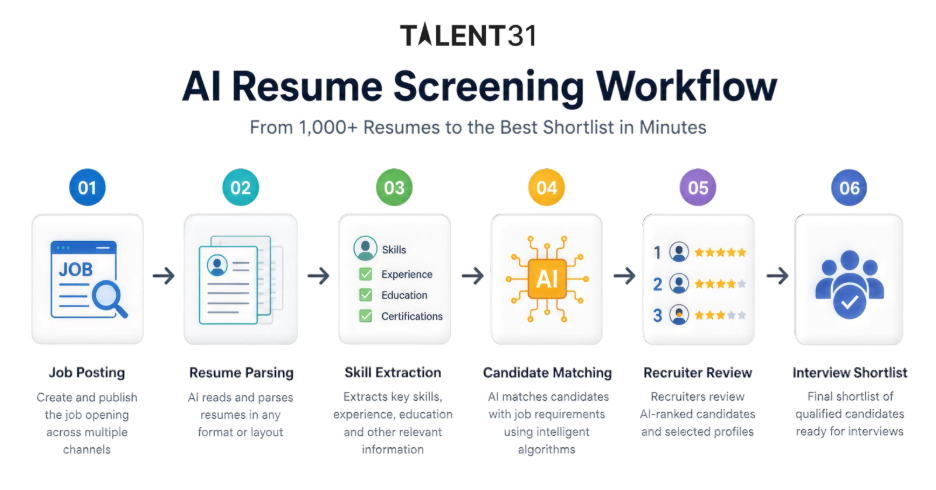
The AI Resume Screening Workflow: From 1,000 Applications to a Qualified Shortlist
One of the biggest reasons organizations are investing in AI resume screening software is its ability to transform an overwhelming hiring process into a structured, intelligent workflow.
Instead of recruiters manually opening every resume, AI performs the first level of evaluation within minutes.
A modern AI-powered hiring platform typically follows this workflow:
Job Posting → Resume Collection → AI Resume Parsing → Skill & Experience Extraction → Candidate Matching → Resume Ranking → Recruiter Review → Interview Shortlist
At each stage, artificial intelligence processes thousands of data points simultaneously. It understands technical skills, experience levels, certifications, job titles, career progression, and even transferable skills that traditional Applicant Tracking Systems (ATS) often overlook.
Rather than eliminating recruiters from the process, AI removes repetitive work so recruiters can focus on what humans do best building relationships, evaluating culture fit, and making strategic hiring decisions.
Why AI Resume Screening Delivers Better Hiring Outcomes
Speed is the first advantage most companies notice.
Quality is the one that creates long-term business value.
Recruiters often assume faster hiring means compromising candidate quality. Modern AI recruitment software proves the opposite.
Instead of reviewing resumes one after another, AI evaluates every application using the same criteria, ensuring consistency throughout the recruitment process.
This helps organizations:
- Reduce time-to-hire significantly
- Improve candidate quality
- Increase recruiter productivity
- Minimize manual errors
- Create a better candidate experience
More importantly, recruiters spend less time searching for qualified candidates and more time engaging with them.
This shift changes recruitment from an administrative function into a strategic business advantage.
Common Myths About AI Resume Screening
As AI adoption grows, so do misconceptions.
One of the most common myths is that AI replaces recruiters.
It doesn't.
AI replaces repetitive screening tasks, not human judgement.
Recruiters still decide whom to interview, evaluate communication skills, assess cultural alignment, negotiate offers, and build long-term relationships with candidates.
Another misconception is that AI only searches for keywords.
Modern AI recruitment platforms go far beyond keyword matching.
They understand relationships between skills, recognize transferable experience, and evaluate contextual information instead of relying solely on exact keyword matches.
Finally, many organizations worry AI introduces bias.
Ironically, structured AI models often reduce unconscious human bias by evaluating candidates using standardised criteria rather than personal assumptions or inconsistent review methods.
When combined with recruiter expertise, AI creates a far more balanced hiring process.
Best Practices for Using AI Resume Screening Successfully
Organizations achieve the best results when AI is used as a decision-support system rather than an automatic hiring tool.
The first step is creating clear job descriptions with defined skill requirements. AI performs best when hiring expectations are well structured.
Recruiters should also review AI-generated shortlists rather than accepting recommendations without evaluation. Human expertise remains essential for assessing communication, motivation, and organizational fit.
Another best practice is continuously refining hiring criteria. As hiring needs evolve, AI models become more effective when they learn from successful placements and recruiter feedback.
Companies that combine AI insights with recruiter experience consistently achieve better hiring outcomes than organizations relying entirely on manual processes.
Why Talent Intelligence Matters More Than Resume Screening
Resume screening is only the beginning.
The future of recruitment is Talent Intelligence.
Modern hiring decisions require understanding much more than what appears on a resume.
Organizations increasingly want answers like
- Which candidate has the highest long-term potential?
- Who is most likely to succeed in this role?
- Which applicants possess transferable skills?
- Who aligns with future workforce requirements?
Traditional screening cannot answer these questions.
This is where Talent Intelligence Platforms are changing recruitment.
By combining resume analysis, candidate matching, workforce insights, and predictive hiring capabilities, organizations can make decisions based on data rather than assumptions.
Platforms like Talent31 extend beyond resume screening by helping recruiters identify high-potential candidates, reduce hiring risks, and build stronger talent pipelines.
How Talent31 Makes AI Resume Screening Smarter
Recruitment today is no longer about simply filling vacancies.
It's about identifying the right people before competitors do.
Talent31 helps organizations move beyond manual recruitment by combining:
- AI Resume Screening
- Intelligent Candidate Matching
- Hiring Automation
- Talent Intelligence
- Recruitment Analytics
Instead of reviewing thousands of resumes manually, recruiters receive prioritized candidate recommendations based on skills, relevance, and hiring requirements.
This reduces administrative effort while improving hiring quality and consistency.
Organizations can build faster, smarter, and more scalable recruitment processes without sacrificing the human element of hiring.
The Future of Resume Screening Is Already Here
The volume of applications will continue to grow.
Candidate expectations will continue to rise.
Hiring timelines will continue to shrink.
The question is no longer whether organizations should adopt AI.
The real question is whether they can remain competitive without it.
Companies that continue relying entirely on manual resume screening will spend more time reviewing applications, lose qualified candidates to faster competitors, and place increasing pressure on already overloaded recruiters.
Meanwhile, organizations embracing AI-powered resume screening, talent intelligence, and recruitment automation are building hiring systems that are faster, more accurate, and better prepared for the future of work.
The best recruiters won't be replaced by AI.
They'll simply outperform those who choose not to use it.
Frequently Asked Questions
What is AI resume screening?
AI resume screening uses artificial intelligence to analyze, rank, and shortlist resumes based on skills, experience, qualifications, and job relevance, helping recruiters review large volumes of applications faster.
How many resumes can AI screen in a day?
Modern AI resume screening software can analyze thousands of resumes within minutes, making it ideal for high-volume recruitment and enterprise hiring.
Does AI resume screening replace recruiters?
No. AI automates repetitive screening tasks, while recruiters remain responsible for interviews, relationship building, and final hiring decisions.
Is AI resume screening more accurate than manual screening?
AI provides consistent, data-driven candidate evaluation and reduces manual errors, but the best hiring outcomes come from combining AI insights with human expertise.
What are the benefits of AI resume screening?
AI resume screening improves hiring speed, reduces time-to-hire, enhances candidate matching, increases recruiter productivity, and creates a more efficient recruitment process.
How does Talent31 improve resume screening?
Talent31 combines AI Resume Screening, AI Candidate Matching, Talent Intelligence, and Recruitment Analytics to help organizations identify qualified candidates faster and make smarter hiring decisions.