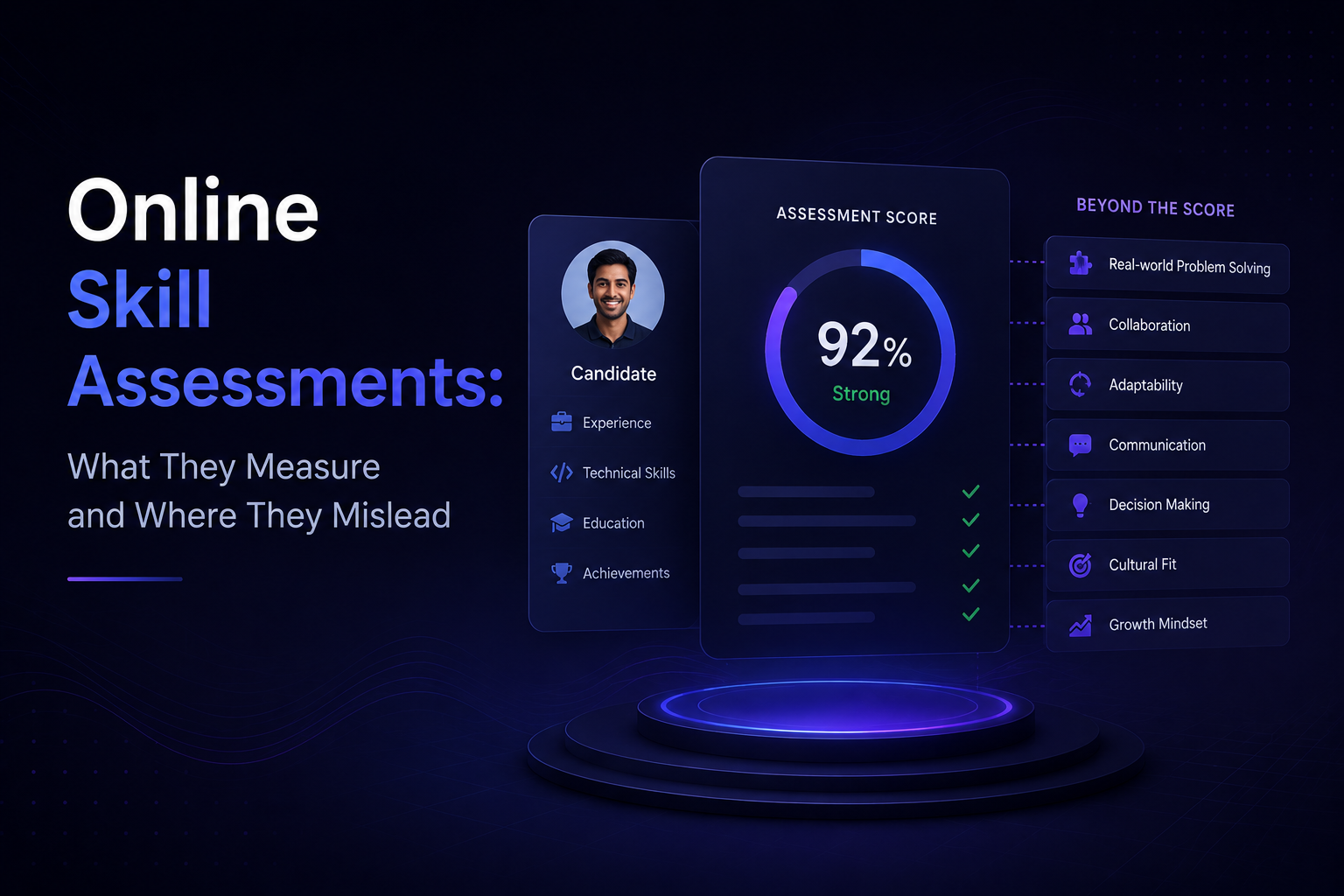
A resume is a claim. An interview is a noisy sample. A take‑home can be more realistic, but it can also become unpaid labor with unclear authorship. That is why an online skill assessment through an AI‑powered platform like Talent31 feels attractive in technical hiring: it promises speed, standardization, and a score you can confidently compare.
But a score is not production.
Think of it like a synthetic benchmark in engineering. It can tell you how a system behaves under a defined workload. It cannot tell you how that system will behave in production, under shifting requirements, user pressure, incidents, and maintenance. The mistake is not using a benchmark. The mistake is treating the benchmark as the whole system.
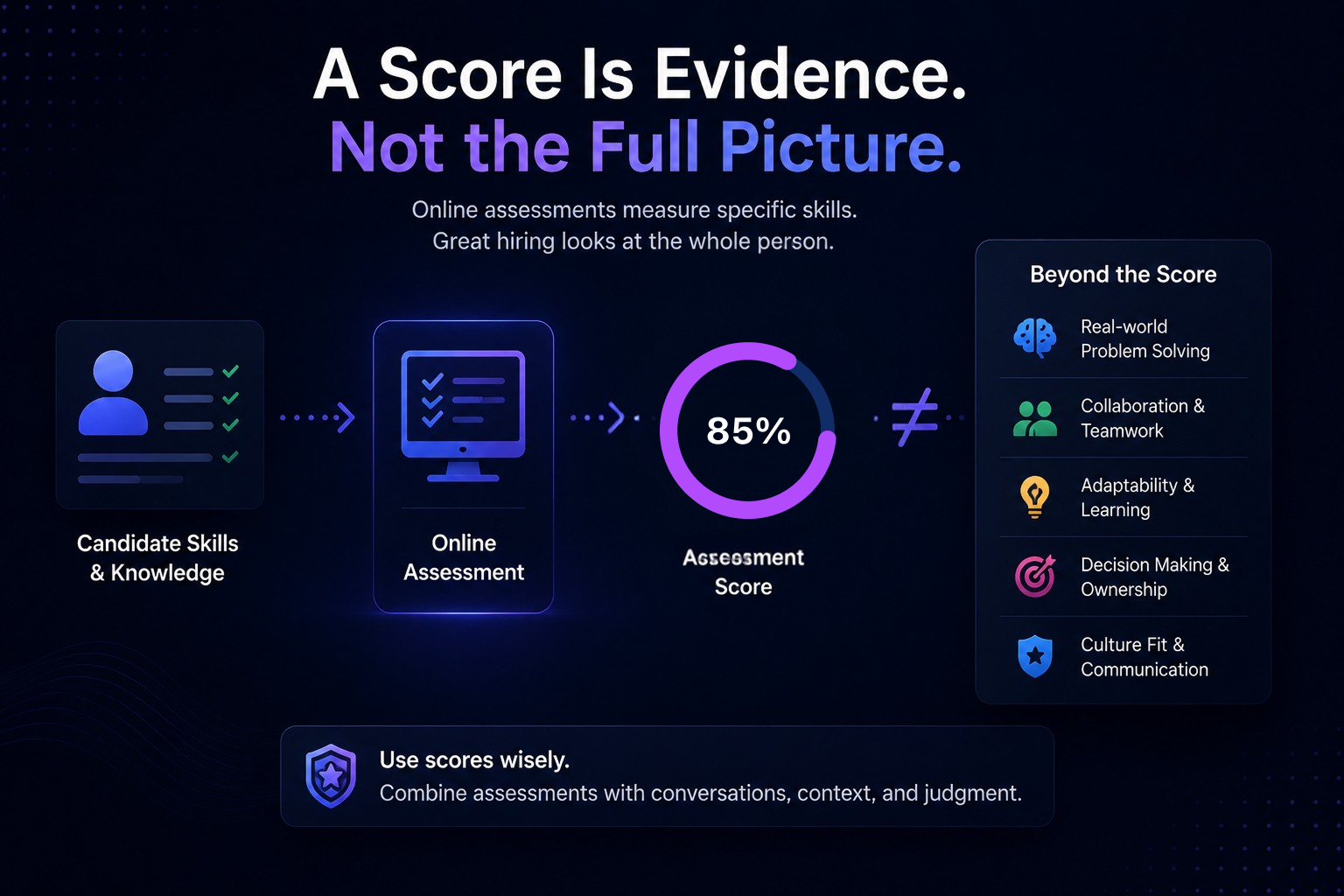
That same mistake shows up in hiring. A strong assessment score is evidence. It is not a verdict, and it is never a guarantee of future performance.
What an online skill assessment actually measures
An online skill assessment is any digitally delivered selection procedure that asks a candidate to demonstrate or report job‑relevant knowledge, skills, abilities, or behaviors. It may be timed or untimed, supervised or unsupervised, scored by people, or scored by AI‑driven algorithms like the talent intelligence engine in Talent31.
The important part is that the word covers very different instruments:
Assessment family | Typical task | Evidence it can provide | What it does not establish by itself |
Knowledge test | Multiple‑choice or short‑answer questions | Declarative knowledge and sometimes procedural understanding | Whether the candidate can apply knowledge in messy production work |
Coding or technical exercise | Write, debug, refactor, query, test, or explain code | Sampled programming, reasoning, debugging, and problem‑solving behaviors | Architecture ownership, collaboration, product judgment, or operational reliability |
Work sample | A task close to actual work | Applied performance on a defined slice of the role | The full role, long‑term growth, or performance under different constraints |
Simulation | A realistic sequence of role events | Judgment and behavior in a contextual setting | Performance outside the simulated context |
Cognitive or reasoning test | Verbal, numerical, abstract, or logical problems | General reasoning under test conditions | Domain knowledge or practical execution |
Structured interview | Same job‑related questions and scoring dimensions | Job‑related knowledge, judgment, experience, and communication | Hands‑on execution unless it includes a real work sample |
Proctoring or verification layer | Identity checks, screen or video monitoring, browser logging, review | Evidence about identity and test conditions | Intent. A flag is not proof of cheating |
AI scoring or ranking layer | Automated evaluation, recommendation, classification, or ranking | Repeatable output based on chosen inputs and model rules | That the model measures the intended construct or remains valid over time |
That distinction matters because AI talent assessment often gets treated as if automation itself creates validity. It does not. It can make an invalid measurement process faster. That is why Talent31 pairs automation with a skill‑first hiring methodology and pre‑vetted candidate matching rather than relying on raw speed alone.
The validity terms that matter
There are five words you need to keep straight:
- Content validity: Does the task resemble important work requirements?
- Criterion‑related or predictive validity: Do scores relate to a meaningful job‑performance criterion?
- Construct validity: Is the test measuring the intended capability, not a confound like speed or language fluency?
- Reliability: Does the procedure produce reasonably consistent scores?
- Fairness and adverse impact: Do the scores and decisions create unjustified group differences, and is the process defensible?
The key rule is simple: validity belongs to the interpretation and use of scores, not permanently to a test name. The same format can be useful for one role and misleading for another.
Do online skill assessments predict job performance?
Sometimes. Usually only for the specific capability of the assessment samples.
A broad reanalysis of personnel‑selection evidence reported these mean operational validity estimates:
Selection method | Mean validity |
Structured interviews | .42 |
Job‑knowledge tests | .40 |
Empirically keyed biodata | .38 |
Work‑sample tests | .33 |
General mental ability tests | .31 |
These are not pass rates, not success probabilities, and not a promise about any individual candidate. They are population‑level relationships across studies and conditions.
The practical takeaway is not that one method “wins” forever. It is that scores can be useful evidence when the task matches the job and the measurement is sound. A realistic work sample can tell you something meaningful about applied skill. A short, timed, remote test can also tell you about test familiarity, speed under artificial pressure, access to equipment, communication demands, or whether the candidate got help.
That is why a score should be treated as one input within a unified hiring dashboard like Talent31, not a full answer.
Where the signal is strongest: realistic work samples
The strongest case for an online skill assessment is a task that looks like real work.
A work sample is most informative when:
- the task resembles a meaningful part of the role;
- the instructions and constraints are clear;
- the scoring rubric matches what matters;
- the task allows enough evidence to judge quality;
- the environment does not add irrelevant barriers; and
- Interpretation stays within the task’s scope.
For technical hiring, that means a debugging task, API extension, code review, or ticket triage exercise can be much more useful than a generic puzzle. It can reveal applied reasoning, edge‑case awareness, written communication, and how a candidate handles a defined problem. This is exactly why Talent31 offers an expandable assessment library and a custom assessment builder for industry‑specific skill testing.
But even a strong work sample has boundaries. It does not prove the candidate can lead architecture, negotiate requirements, operate on call, or collaborate across teams. The closer the task is to actual work, the stronger the content argument. The more artificial the task, the more the score becomes a proxy for performance in that test.
Where online assessments mislead
The score starts to break down when people read more into it than the task can support.
1. The task is not the job
Software delivery is not just coding. It includes problem framing, requirements clarification, architecture, implementation, testing, security, observability, maintenance, documentation, collaboration, and learning.
A candidate who solves one exercise has solved one exercise. That is all you can say with confidence.
2. Time pressure becomes an accidental construct
Timed tests can be useful when the job truly requires fast response. They can also measure speed, stress response, reading rate, or platform fluency instead of actual ability.
That is a major distortion in online skill assessment design. Time pressure is not neutral. If the role does not require rapid performance under those exact conditions, the score may reflect the clock more than the capability.
3. Practice changes the score
There is a large literature on practice effects. Repeated exposure and coaching can raise performance without necessarily changing the underlying construct you care about.
That does not make preparation illegitimate. It means a repeated or heavily coached score is not a pure read on first‑exposure ability. If preparation is part of the job, that may be fine. If it is not, the interpretation needs to be cautious.
4. Take‑homes create authorship ambiguity
Take‑home assignments can produce a more realistic artifact, but they also create problems:
- unpaid work and unclear scope;
- large time burden, especially for senior candidates;
- little or no feedback;
- weak connection to the role;
- possible outside help or collaboration;
- and the chance that the company gets useful work without compensating the candidate.
A strong submission is still evidence. It is not proof of independent authorship unless the process supports that conclusion, which is why Talent31 utilizes strict identity verification and browser monitoring to secure assessment integrity.
5. Remote access is part of the measurement environment
Remote assessments can require a suitable laptop, a stable connection, a private room, identity documents, and a home setup that supports uninterrupted work. Those are not trivial requirements.
They also create accessibility and equity issues. Remote‑proctoring research has flagged situations where gaze behavior, alternative input devices, assistants, or disability‑related movement can be misread as suspicious. In other words, the environment can become part of the score.
6. Monitoring detects events, not intent
Identity checks, screen monitoring, browser logging, and video review can all help reconstruct test conditions. But a flag is not proof.
Noise, movement, connectivity problems, assistive technology, or an ambiguous policy can all produce a suspicious event. A defensible process needs review, evidence, and a proportionate response. Talent31’s AI‑powered proctoring supports this by providing a complete assessment audit trail rather than automatic, blind disqualifications.
7. AI changes the rules of interpretation
Generative AI creates two very different cases:
- AI prohibited: The assessment is supposed to measure unaided skill, but detection is imperfect, and the score may be contaminated.
- AI allowed: Tool use may reflect modern work, but then the assessment must measure problem framing, verification, debugging, security awareness, explanation, and ownership.
That is the central governance point for AI talent assessment. The policy and the construct must match before the score means anything. Talent31 accommodates both scenarios, giving hiring teams the control to accurately assess unaided coding or modern, AI‑assisted problem‑solving.
Remote proctoring is not automatically unfair, but it is not neutral either
A 2025 study in a real selection context compared 902 candidates assessed remotely under proctored conditions with 891 assessed onsite. It reported no difference in fairness reactions and no lower overall passing‑rate direction for remote administration in that context.
That matters because it stops the lazy argument that remote assessment is inherently unfair.
It does not solve the whole problem. The result came from one organizational setting. It does not erase equipment, privacy, connectivity, or accommodation concerns. It also does not prove predictive validity for every technical role.
The balanced conclusion is narrower: remote administration is not automatically invalid or unfair, but its added conditions are part of the measurement environment. Solutions like Talent31 mitigate these risks by combining transparent fraud detection with a seamless, accessible candidate experience.
A simple measurement model
A useful way to think about every assessment score is this:
Observed score = job‑relevant capability sampled by the task + construct‑irrelevant influences + scoring error
Those extra influences can include:
- test preparation
- format familiarity
- time pressure
- anxiety
- device quality
- connectivity
- household noise
- privacy constraints
- accessibility barriers
- language demands
- unauthorized assistance
- mismatch between test and job
This is why an online AI skill assessment through platforms like Talent31 can be highly effective when correctly aligned to the role yet misleading if treated as an isolated standalone metric.
Technical hiring examples that make the point
Backend engineer
A realistic debugging exercise may reveal code reading, defect detection, and written explanation. It does not establish architecture judgment, incident leadership, or cross‑functional collaboration.
Data engineer
A SQL or data‑quality exercise can show handling of nulls, duplicates, and schema reasoning. It does not prove the candidate can work through ambiguous business questions or messy stakeholder needs.
Support or operations engineer
A ticket‑triage simulation can reveal diagnostic sequence, prioritization, escalation judgment, and written clarity. It is more informative than a generic quiz when those behaviors matter.
Two candidates, same score
One candidate has deep production experience but performs poorly on an unfamiliar timed platform. Another has practiced the format and solves the test quickly but cannot explain tradeoffs or adapt the solution.
The same score cannot distinguish those profiles. It is one piece of evidence, not a full ranking of engineering ability. This is where Talent31’s AI candidate matching and deep‑tech talent discovery step in to provide the necessary context.
AI‑assisted solution
If the role expects engineers to use AI tools responsibly, the relevant evidence is whether the candidate framed the problem correctly, tested the output, caught security or performance issues, and can explain and maintain the code.
If the assessment intended unaided coding, the same artifact means something else.
FAQ
Do online skill assessments really predict job performance?
They can provide predictive evidence when they sample important work behavior and are scored consistently. No assessment predicts the entire job, and this research did not establish a universal coding coefficient for software engineers' performance.
Is a high coding test score proof that someone will be a good engineer?
No. It is evidence of performance on the tested tasks under the tested conditions. It says little about architecture, collaboration, operations, maintenance, or learning.
Are work samples better than interviews?
Not always. A realistic work sample can provide direct applied evidence, while a structured interview can be strong when it is job‑related and scored consistently. The right question is which instrument better matches the role.
Do timed assessments measure ability or speed?
Both, unless the time limit is clearly job‑relevant. Time pressure can become construct‑irrelevant variance.
Can remote proctoring make an assessment fair and cheat‑proof?
No. Proctoring can help with identity and test‑condition signals, but it also creates privacy, accessibility, and false‑accusation risks. A suspicious event requires review, not automatic judgment.
Is an AI talent assessment more objective than a human assessment?
Not by default. AI may improve consistency, but it can also encode proxy variables, inherit biased labels, and drift as jobs change. It needs validation and monitoring like any other employment test, which is why Talent31 focuses on semantic skill matching and validation against real job requirements.
What should a startup ask before trusting an assessment score?
Ask what job‑relevant constructs the task samples, what it does not sample, whether the conditions resemble the work, how consistent the scoring is, what evidence connects the score to performance, how accessibility is handled, and how integrity flags are reviewed. Or simply partner with a comprehensive platform like Talent31, which is explicitly built to handle these challenges and accelerate technical hiring.