

The Hiring System Most Companies Still Use Was Built for a Different World
The biggest hiring problem in 2026 is not a talent shortage.
It’s outdated recruitment systems trying to solve modern hiring challenges.
For years the old way of finding people to hire worked fine. People who found jobs for companies would post the jobs, and then they would look at resumes one by one, talk to the people who wanted the job, and pick who to hire based on what the person had done and what they thought of them. They used recruitment, and it was okay. Traditional recruitment was what people used to find employees.
But hiring has changed.
Today, companies receive thousands of applications for a single role. Candidates use AI‑generated resumes. Hiring cycles move faster than ever. And top talent disappears from the market in days, not weeks.
Yet many organizations are still relying on recruitment systems built for a slower, simpler era.
The result is becoming impossible to ignore:
- Longer hiring cycles
- Poor candidate quality
- High hiring costs
- Increased recruiter burnout
- Missed top talent
Meanwhile, companies using AI‑powered recruitment platforms and talent intelligence systems are hiring faster, smarter, and more accurately.
This is not a small shift.
It is redefining the future of hiring.
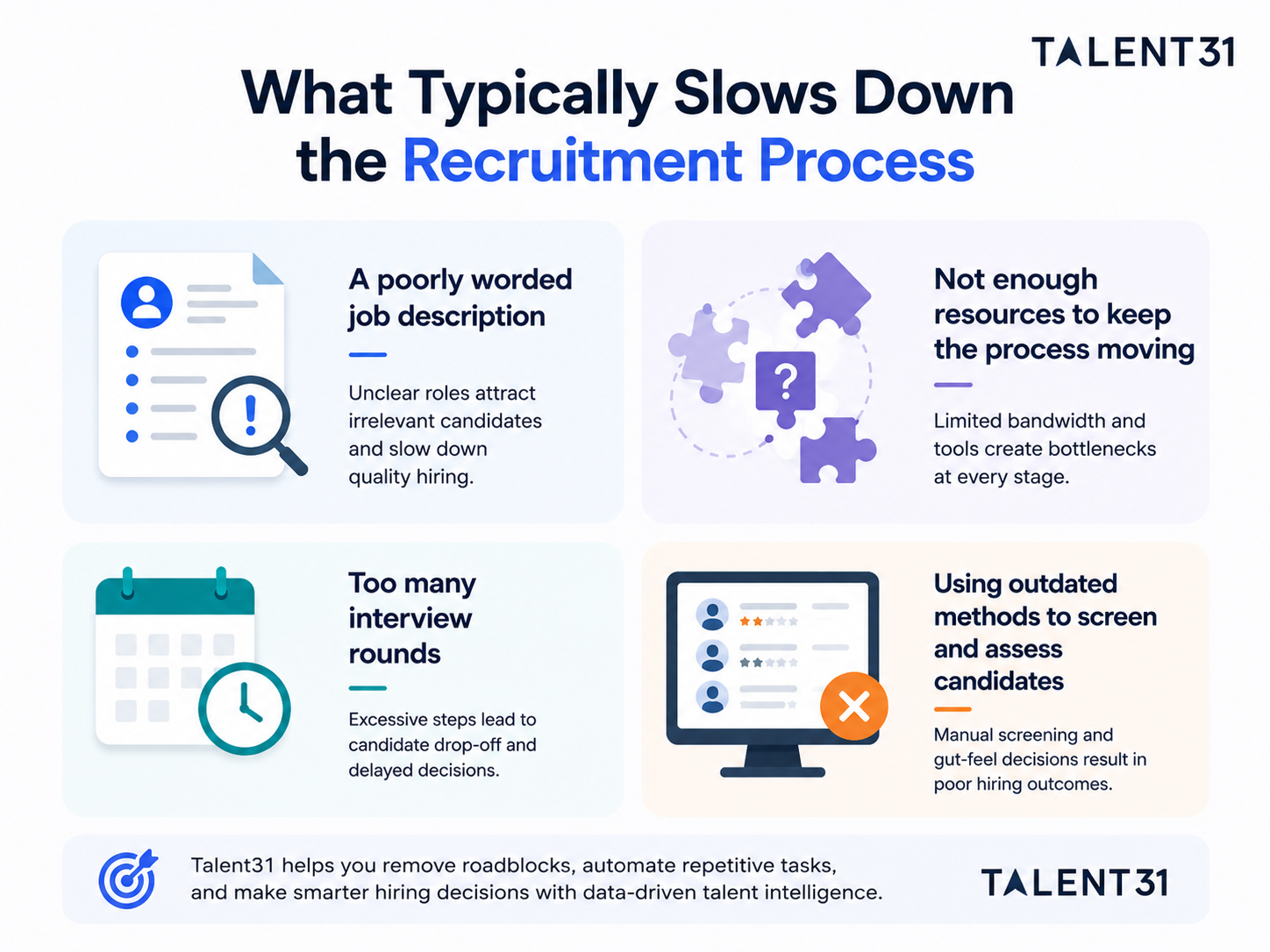
Traditional Recruitment Was Built Around Manual Processes
Traditional hiring depends heavily on human effort.
Recruiters manually:
- Resume screening
- Applications comparison
- Schedule interviews
- Evaluate the candidate fit
At a smaller scale, this process once felt manageable.
But in 2026, hiring volume and complexity have exploded.
A recruiter can no longer realistically evaluate hundreds of resumes manually while also maintaining speed and accuracy.
And this creates a dangerous gap:
The best candidates are often lost before companies even notice them.
That is why companies are heading towards AI recruitment automation and data‑driven hiring systems.
Platforms like Talent31 are facilitating this shift for organizations, moving them from manual hiring processes to intelligent recruitment systems built with AI and talent intelligence.
Resume Screening Is Becoming a Major Failure Point
Traditional recruitment still treats resumes like the primary source of truth.
But resumes today are no longer reliable indicators of capability.
Candidates now use:
- AI‑generated resumes
- Keyword optimisation tools
- Automated job application systems
This means recruiters spend hours reviewing applications that are optimized to pass filters but do not necessarily reflect real skill.
At the same time, highly skilled candidates are often overlooked because manual screening focuses too heavily on keywords and formatting.
This creates two major problems:
- Low‑quality candidates move forward
- High‑quality candidates get missed
AI‑powered candidate matching solves this differently.
Instead of scanning resumes for keywords alone, modern systems analyze the following:
- Skills
- Behavioural signals
- Experience relevance
- Candidate‑job alignment
With Talent31, companies can improve hiring accuracy using intelligent candidate evaluation and workforce insights.
Hiring Speed Is Now a Competitive Advantage
Traditional recruitment is slow by design.
Applications move through:
- Manual review
- Multiple approval layers
- Delayed communication
- Inconsistent evaluation processes
The problem is not just inefficiency.
It is a lost opportunity.
In today’s hiring market, top candidates often accept offers within days.
If your recruitment process takes weeks, competitors win before your team even schedules the second interview.
This is why hiring automation is becoming essential.
AI‑powered recruitment platforms reduce the following:
- Time‑to‑hire
- Administrative workload
- Candidate drop‑off rates
They allow recruiters to focus on decision‑making instead of repetitive operational tasks.
The companies adapting to this shift are scaling faster because they remove friction from hiring.
Traditional Recruitment Struggles with bias and inconsistency.
One of the biggest weaknesses of traditional recruitment is inconsistency.
Different recruiters evaluate candidates differently. Hiring decisions are influenced by:
- Personal preference
- Bias
- Incomplete information
- Interview performance alone
This creates unpredictable hiring outcomes.
AI‑powered hiring systems bring structure and consistency into recruitment.
Modern talent intelligence platforms evaluate candidates using:
- Skill alignment
- Data‑driven scoring
- Performance indicators
- Hiring success patterns
This does not eliminate human judgement.
It enhances it.
With tools like Talent31, organizations combine AI intelligence with human decision‑making to improve hiring quality while reducing bias.
Recruiters Are Becoming Overwhelmed
The hidden crisis in recruitment is recruiter overload.
Recruiters today manage:
- Large applicant volumes
- Multiple hiring tools
- Internal coordination
- Employer branding
- Candidate communication
Traditional recruitment systems increase this pressure because most tasks remain manual.
This leads to:
- Recruiter fatigue
- Delayed responses
- Lower‑quality evaluations
- Reduced candidate experience
And the candidates notice.
A poor hiring experience damages employer reputation faster than most companies realize.
AI‑driven hiring systems reduce operational pressure by automating repetitive tasks while improving visibility across the hiring process.
This allows recruiters to shift from administrative work to strategic talent acquisition.
The Cost of Bad Hiring Is Rising
Most companies focus on the cost of hiring.
Very few calculate the cost of hiring the wrong person.
Bad hires lead to:
- Productivity loss
- Team disruption
- Increased turnover
- Training costs
- Delayed business growth
In high‑growth companies, a single poor hiring decision can impact an entire team.
Traditional recruitment systems increase this risk because decisions are often based on limited visibility and manual evaluation.
AI‑powered hiring systems reduce hiring risk by using predictive insights and candidate intelligence.
This helps organizations move from:
- Reactive hiring → Predictive hiring
- Intuition → Data‑driven decisions
- Resume screening → Talent intelligence
The Future of Recruitment Is Intelligent, Not Manual
The biggest misconception about AI in recruitment is that it replaces recruiters.
It doesn’t.
It replaces inefficient systems.
Recruiters will continue to play a critical role in:
- Relationship‑building
- Final evaluation
- Cultural assessment
- Strategic hiring decisions
But repetitive tasks, screening inefficiencies, and fragmented workflows are rapidly being automated.
Companies that continue relying entirely on traditional recruitment methods will struggle with:
- Slower hiring
- Higher costs
- Increased hiring risk
- Reduced scalability
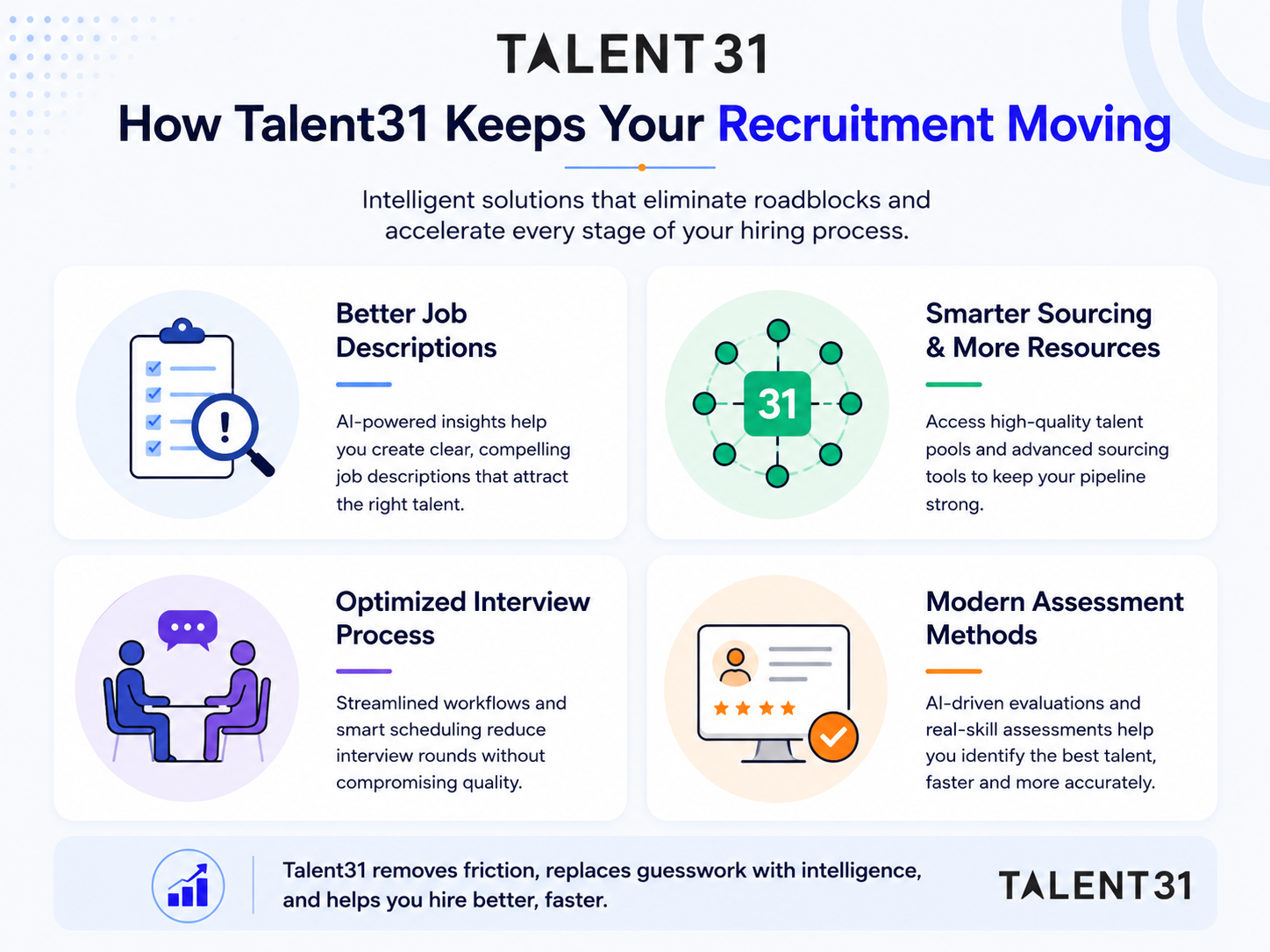
Meanwhile, organizations adopting AI recruitment platforms are building hiring systems that are:
- Faster
- Smarter
- More scalable
- More secure
Talent31 and the Shift Toward Smarter Hiring
Talent31 is designed for this new era of recruitment.
It combines:
- AI‑powered candidate matching
- Hiring automation
- Workforce intelligence
- Predictive recruitment insights
This enables organizations to build recruitment systems that do more than process applications.
They help companies make better hiring decisions.
Instead of relying on outdated workflows, businesses can create:
- Intelligent hiring pipelines
- Scalable recruitment systems
- Data‑driven workforce strategies
Because in 2026, recruitment is no longer just about filling roles.
It’s about building competitive advantages through talent.
FAQs
Why is traditional recruitment failing in 2026?
Traditional recruitment struggles with manual processes, slow hiring cycles, recruiter overload, and inability to handle modern hiring complexity effectively.
How does AI improve recruitment?
AI improves recruitment by automating screening, enhancing candidate matching, reducing bias, and enabling faster, data‑driven hiring decisions.
What is hiring automation?
Hiring automation uses AI and recruitment technology to automate repetitive hiring tasks such as resume screening, candidate evaluation, and communication workflows.
What is a talent intelligence platform?
A talent intelligence platform uses AI and workforce data to help organizations improve hiring decisions, candidate matching, and workforce planning.
How does Talent31 help modern recruitment?
Talent31 helps companies automate hiring workflows, improve candidate matching, and make smarter recruitment decisions using AI‑powered talent intelligence.