
Recruiters need more than resumes and interviews to identify the right candidates. As hiring volumes increase and job requirements become more specialized, evaluating candidates consistently has become a major challenge for HR teams. A structured Pre‑Employment Assessment process helps recruiters understand a candidate’s skills, knowledge, problem‑solving ability, and suitability for a role before making a hiring decision.
Traditional screening methods can take considerable time, particularly when recruiters receive hundreds of applications for a single position. Online tests, technical evaluations, behavioral assessments, and automated scoring can help organizations make the process more structured and efficient.
However, choosing the right platform is not always straightforward. Some tools focus on technical skills, while others specialize in personality assessments, cognitive ability, job simulations, or high‑volume recruitment.
In this guide, we explore 24 assessment platforms, their key capabilities, and the types of hiring needs they support. We also explain what recruiters should consider before selecting a solution.
Key Takeaways: Why Pre‑Employment Assessment Matters in 2026
- Evaluate candidates beyond their resumes: A structured pre‑employment assessment helps recruiters measure job‑related skills, knowledge, and capabilities.
- Choose platforms based on hiring requirements: The right pre‑employment assessment platform can support technical, behavioral, cognitive, and role‑specific evaluations.
- Look for customization: Customizable pre‑employment assessment tests help recruiters evaluate candidates according to specific job roles and required skills.
- Prioritize candidate experience: A smooth and accessible pre‑employment assessment process can reduce unnecessary friction during recruitment.
- Use results to support hiring decisions: A pre‑employment assessment provides valuable insights, but results should complement interviews, experience, and recruiter judgment.
In This Guide, You'll Learn
- What assessment platforms are and how they work.
- Why recruiters use online assessment tools.
- The 24 platforms worth considering in 2026.
- Key features to compare before selecting a solution.
- How to choose a platform for technical and non‑technical hiring.
What Is a Pre‑Employment Assessment?
A pre‑employment assessment is an evaluation method used by employers to measure whether a candidate has the skills, knowledge, abilities, and behavioral characteristics required for a particular job.
These evaluations can take different forms depending on the position and organization. For example, a software developer may complete a coding test, while a sales candidate may be evaluated through a situational judgment test or communication exercise.
Common assessment formats include:
- Technical skills tests: Evaluate programming, software, engineering, and other job‑specific technical abilities.
- Cognitive ability tests: Measure reasoning, numerical ability, logical thinking, and problem‑solving.
- Personality assessments: Help understand behavioral preferences and working styles.
- Situational judgement tests: Present workplace scenarios and evaluate how candidates respond.
- Language and communication tests: Assess written and verbal communication skills.
- Job simulations: Recreate practical tasks that candidates may perform in the role.
These tools give recruiters additional information to support screening and selection. They are most useful when the evaluation criteria are connected to the actual responsibilities of the position.
Why Do Recruiters Need a Pre‑Employment Assessment?
Recruitment teams often face challenges such as high application volumes, inconsistent screening, limited evaluation time, and difficulty comparing candidates objectively.
Online assessment platforms help address these challenges by providing structured ways to evaluate applicants.
1. More Consistent Candidate Evaluation
When every candidate is evaluated using the same job‑related criteria, recruiters can compare results more consistently. This can reduce reliance on informal impressions during early‑stage screening.
2. Reduced Manual Screening Effort
Automated invitations, scoring, and reporting can reduce repetitive administrative work. Recruiters can spend more time reviewing qualified candidates and conducting meaningful interviews.
3. Better Understanding of Job‑Related Skills
A resume may describe a candidate's experience, but it does not always demonstrate their ability to perform a task. Practical tests can provide additional evidence of relevant capabilities.
4. Support for High‑Volume Hiring
Organisations hiring for multiple positions or locations may need to evaluate large numbers of applicants. A digital assessment process can help manage invitations, submissions, and results in one place.
5. More Structured Hiring Decisions
Assessment reports can give recruiters and hiring managers a common reference point when discussing candidates. However, results should be considered alongside interviews, work experience, and other relevant evidence.
How Does a Pre‑Employment Assessment Work?
Most platforms follow a similar evaluation process, although available features differ by provider.
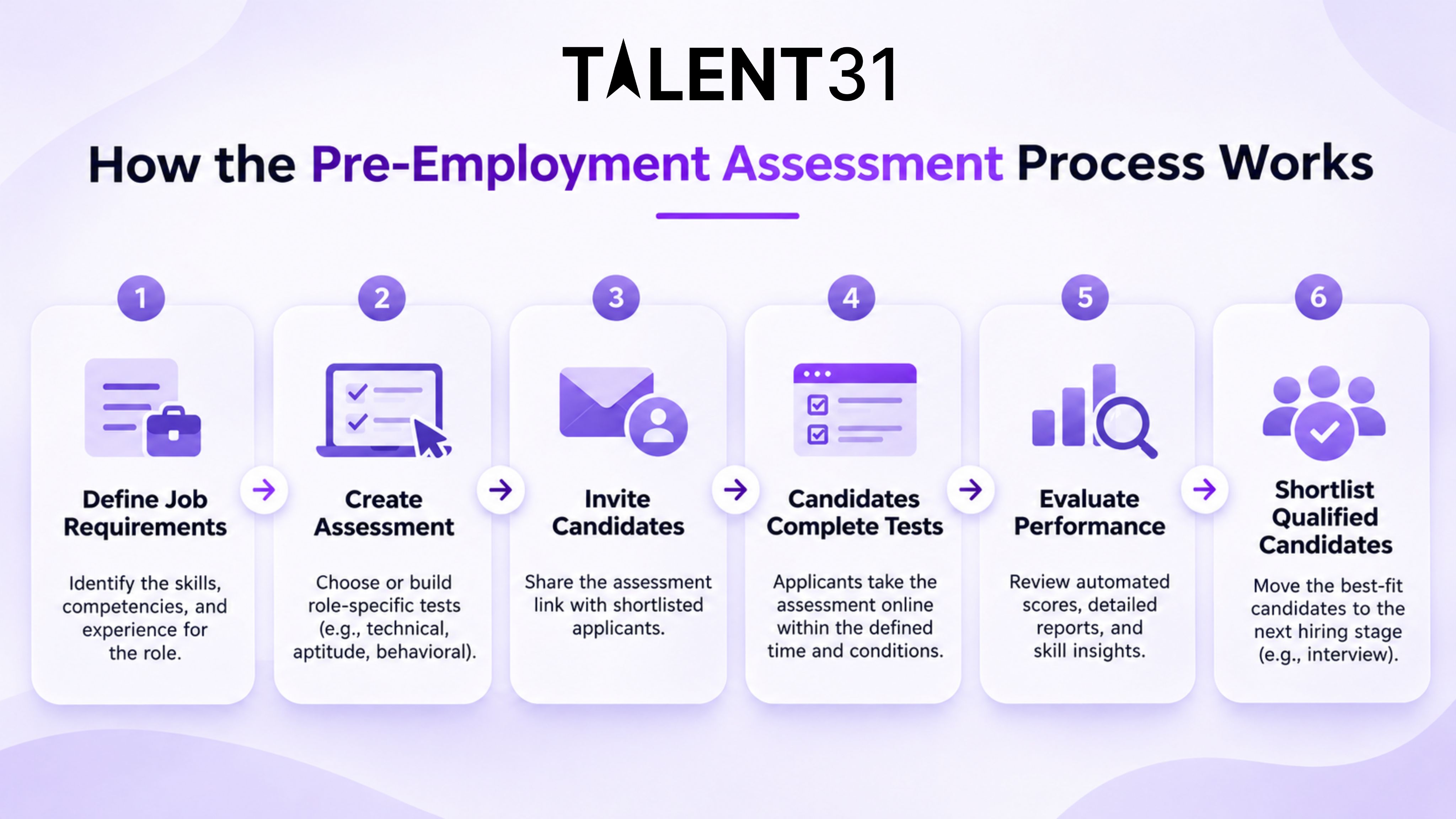
A Typical Candidate Assessment Workflow
- Define the job requirements: Identify the skills, competencies, and experience required for the position.
- Select or create an assessment: Choose relevant questions, tests, or practical exercises.
- Invite candidates: Share an assessment link with shortlisted applicants.
- Candidates complete the test: Applicants attempt the assessment within the configured time and conditions.
- Review results: Recruiters examine scores, responses, reports, and other available evaluation data.
- Move suitable candidates forward: Use the results alongside interviews and other selection criteria to decide the next hiring stage.
24 Best Pre‑Employment Assessment Platforms for Recruiters in 2026
There are several platforms available for candidate evaluation, but they do not all solve the same hiring problems. Some are designed for technical recruitment, while others support general aptitude, personality, behavioural, and job‑specific testing.
The following list provides an overview of 24 platforms and their main areas of focus. It is a practical selection guide, not a ranked performance study.
Quick Comparison of the 24 Platforms
Platform | Main focus | Best suited for |
Talent31 | Technical and non‑technical assessments, AI matching | Recruitment teams managing multiple hiring stages |
TestGorilla | Skills, cognitive, and personality tests | General hiring across departments |
Mercer Mettl | Technical, aptitude, and psychometric testing | Enterprise and campus recruitment |
HackerRank | Coding and technical skills | Software engineering recruitment |
Criteria | Cognitive, behavioural, and skills testing | Structured candidate evaluation |
SHL | Psychometric and talent assessments | Enterprise and global hiring |
Testlify | Technical and non‑technical skills tests | Growing recruitment teams |
iMocha | Technical and digital skills assessment | IT and skills‑based hiring |
HireVue | Video interviews and assessments | High‑volume enterprise recruitment |
Vervoe | Job simulations and practical tasks | Skills‑first hiring |
Xobin | Technical and aptitude assessments | Campus and corporate recruitment |
eSkill | Job‑based skills and aptitude tests | Role‑specific candidate screening |
The Predictive Index | Behavioural and cognitive assessments | Behavioural insights and talent decisions |
Wonderlic | Cognitive ability and personality testing | Reasoning and aptitude evaluation |
Canditech | Job simulations and skills tests | Technical and non‑technical roles |
Bryq | Cognitive and personality assessments | Data‑informed talent selection |
Codility | Coding and engineering assessments | Software developer hiring |
CodeSignal | Technical skills and coding assessments | Engineering teams |
HackerEarth | Coding tests and technical challenges | Developer screening and recruitment |
Harver | High‑volume and frontline hiring assessments | Customer service and operational roles |
Aon Assessment Solutions | Psychometric and talent assessments | Large organisations and enterprise hiring |
Talview | Assessments, interviews, and proctoring | Distributed and high‑volume recruitment |
Adaface | Technical and role‑based skills tests | Technical and non‑technical screening |
Alooba | Data and technical skills assessments | Data and analytics recruitment |
1. Talent31
Best for: AI‑supported recruitment, candidate matching, and technical and non‑technical assessments
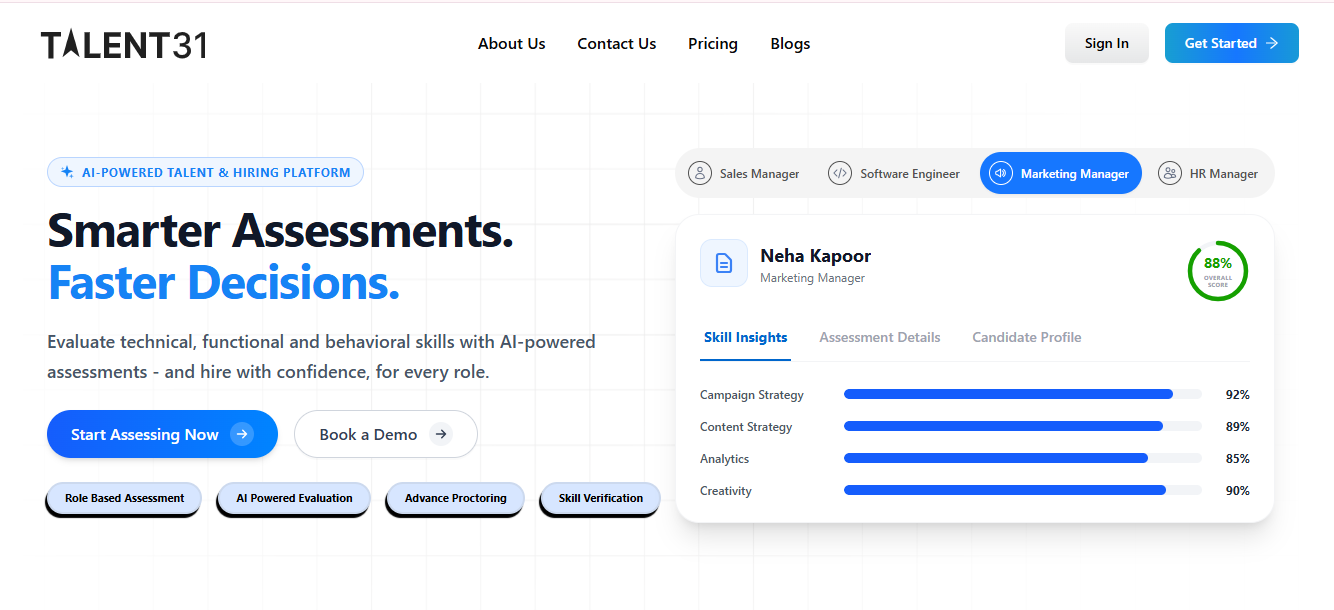
Talent31 is an AI‑powered recruitment platform designed to support candidate discovery, evaluation, and management. It brings multiple recruitment activities into one workflow, helping HR teams manage candidate information and assess applicants against job requirements.
Recruiters can define their hiring requirements and use AI‑powered candidate matching to identify profiles relevant to the role. The platform also supports candidate database management, allowing organisations to import their own candidate records and manage applicants through the recruitment process.
Key Highlights:
- AI‑powered candidate matching based on job requirements and skills.
- Candidate database management for importing and organising candidate profiles.
- Technical and non‑technical skills assessments.
- AI‑led conversational interview capabilities.
- Proctoring features designed to support assessment integrity.
- Candidate pipeline management and assessment reporting.
Best for: Recruitment teams that want candidate discovery, assessment, and candidate management capabilities in one platform.
2. TestGorilla
Best for: General skills‑based hiring across different departments
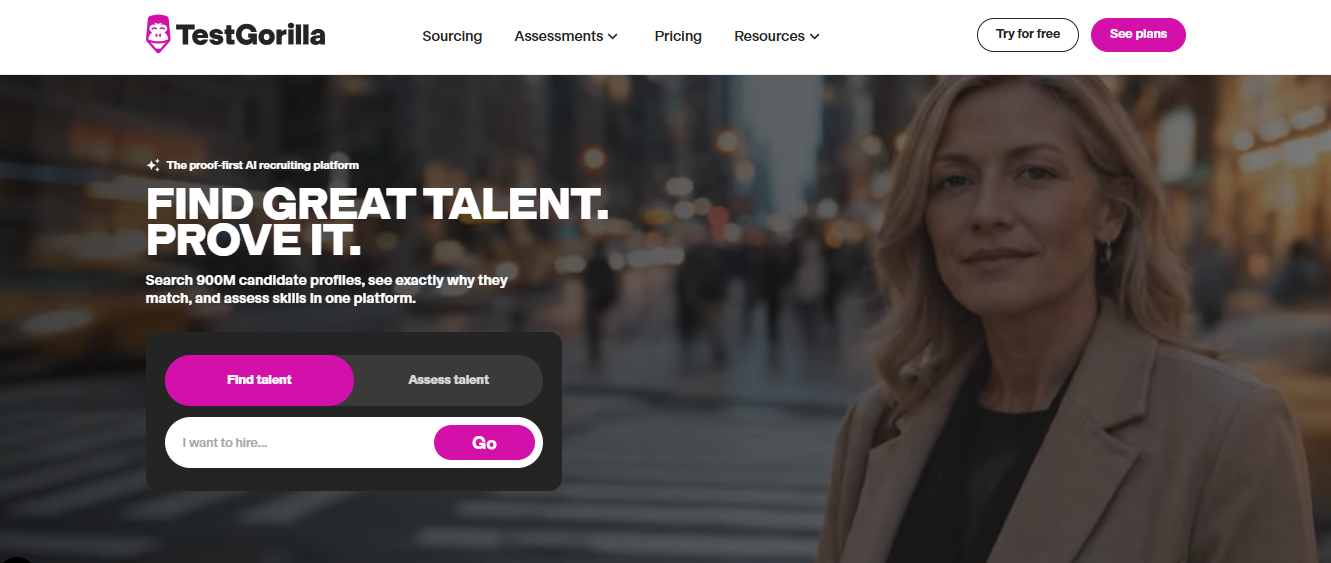
TestGorilla is a candidate testing platform that offers assessments across technical skills, cognitive abilities, personality, and other job‑related competencies.
Recruiters can combine multiple tests to create an evaluation process based on the position. This can be useful for organisations hiring across departments such as sales, customer support, marketing, operations, and technology.
Key Highlights:
- Broad library of skills and aptitude tests.
- Cognitive ability and personality assessments.
- Customisable candidate test combinations.
- Candidate reporting and comparison features.
- Integrations with selected applicant tracking systems.
Best for: Companies that need a broad assessment library for hiring across multiple job functions.
3. Mercer | Mettl
Best for: Enterprise assessments, campus hiring, and proctored testing
Mercer Mettl provides assessment solutions for recruitment, learning, and talent development. Its offerings cover technical skills, aptitude, behavioural competencies, and psychometric evaluations.
The platform also supports online examination and proctoring requirements. This makes it relevant to organisations that need structured assessments for large candidate groups, including campus recruitment and enterprise hiring programmes.
Key Highlights:
- Technical and domain‑specific assessments.
- Aptitude and psychometric testing.
- Online examination and proctoring capabilities.
- Custom assessment creation.
- Reporting and analytics for candidate evaluation.
Best for: Enterprises, educational institutions, and organisations conducting large‑scale assessments.
4. HackerRank
Best for: Software engineering and developer recruitment
HackerRank is a technical hiring platform focused on evaluating programming and software development skills. Recruiters and engineering teams can use coding challenges to understand how candidates approach technical problems.
The platform is particularly relevant for companies hiring developers across programming languages, frameworks, and technical specialisations.
Key Highlights:
- Coding challenges and technical tests.
- Programming language‑based evaluations.
- Technical interview capabilities.
- Automated evaluation of coding submissions.
- Tools for comparing candidate performance.
Best for: Technology companies and engineering teams that need to evaluate developer skills before technical interviews.
5. Criteria
Best for: Cognitive ability, personality, and behavioural assessments
Criteria offers talent assessment solutions focused on understanding candidate abilities and workplace characteristics. Its assessment categories include cognitive aptitude, personality, emotional intelligence, and job‑related skills.
Recruiters can use these evaluations to gather structured information about candidates beyond their resumes and interview responses.
Key Highlights:
- Cognitive aptitude assessments.
- Personality and behavioural evaluations.
- Emotional intelligence testing.
- Skills assessments.
- Candidate assessment reports.
Best for: Organisations that want structured cognitive and behavioural information to support hiring decisions.
6. SHL
Best for: Enterprise talent assessment and psychometric testing
SHL provides assessment and talent solutions for organisations across industries. Its offerings include cognitive ability tests, personality assessments, situational judgement tests, and skills evaluations.
The platform is used in recruitment and wider talent management activities, including identifying potential, evaluating competencies, and supporting workforce development.
Key Highlights:
- Cognitive and aptitude assessments.
- Personality and behavioural testing.
- Situational judgement tests.
- Skills and competency evaluations.
- Enterprise talent assessment solutions.
Best for: Large organisations that require structured assessments across different roles, departments, and locations.
7. Testlify
Best for: Technical and non‑technical skills screening
Testlify provides online tests designed to help recruiters evaluate candidates across technical and non‑technical skills. It supports hiring teams looking to assess applicants before moving them to later recruitment stages.
Its assessment categories cover areas such as programming, aptitude, communication, and other workplace skills.
Key Highlights:
- Technical and non‑technical tests.
- Role‑based assessment options.
- Custom assessment capabilities.
- Automated evaluation and reporting.
- Recruitment workflow integrations.
Best for: Small and growing businesses that want structured candidate screening across different roles.
8. iMocha
Best for: IT skills assessment and workforce skills intelligence
iMocha focuses on evaluating technical and professional capabilities. It offers assessments across areas such as software development, IT, data, and other business skills.
In addition to recruitment, organisations can use its skills intelligence capabilities to understand employee competencies and identify areas for development.
Key Highlights:
- Technical and IT skills assessments.
- Digital and business skills evaluations.
- Coding and domain‑specific tests.
- Skills analytics and reporting.
- Enterprise assessment integrations.
Best for: IT organisations and enterprises that need to assess technical capabilities across candidates and employees.
9. HireVue
Best for: Enterprise hiring, video interviews, and candidate evaluation
HireVue combines digital interviewing and assessment capabilities to support recruitment teams. Its solutions include structured interviews, skills assessments, and other evaluation methods designed for different hiring requirements.
The platform is particularly relevant to organisations managing large recruitment programmes where consistent candidate evaluation and interview workflows are important.
Key Highlights:
- Digital and video interviewing.
- Skills and job‑related assessments.
- Structured interview workflows.
- Candidate evaluation tools.
- Enterprise recruitment integrations.
Best for: Large organisations and recruitment teams managing high‑volume hiring.
10. Vervoe
Best for: Practical, job‑simulation‑based candidate evaluation
Vervoe focuses on evaluating candidates through practical tasks that reflect real workplace activities. Instead of relying only on traditional questions, recruiters can use job‑related exercises to understand how applicants approach tasks.
This approach can be useful when employers want to evaluate practical ability rather than relying entirely on qualifications or self‑reported experience.
Key Highlights:
- Job simulation assessments.
- Customisable skills tests.
- Practical task‑based evaluation.
- Candidate performance insights.
- Assessment workflows for different roles.
Best for: Employers that want candidates to demonstrate practical skills through role‑related tasks.
11. Xobin
Best for: Technical hiring, aptitude testing, and campus recruitment
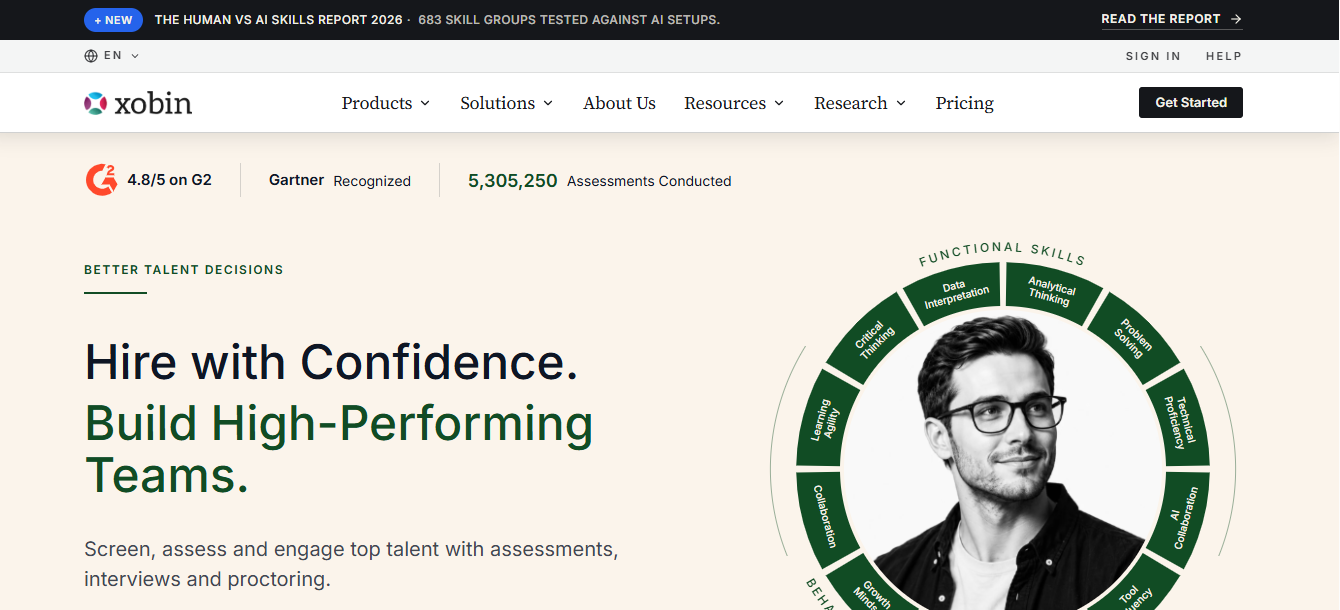
Xobin provides online testing solutions for recruiters and organisations. Its assessment options include technical, aptitude, and other job‑related evaluations.
Recruitment teams can use the platform to conduct assessments for different positions and review candidate performance through available reports.
Key Highlights:
- Technical and coding assessments.
- Aptitude and domain‑specific tests.
- Custom test creation.
- Candidate performance reports.
- Online assessment management.
Best for: Companies and educational institutions conducting technical hiring and campus recruitment.
12. eSkill
Best for: Job‑based skills testing and role‑specific evaluations
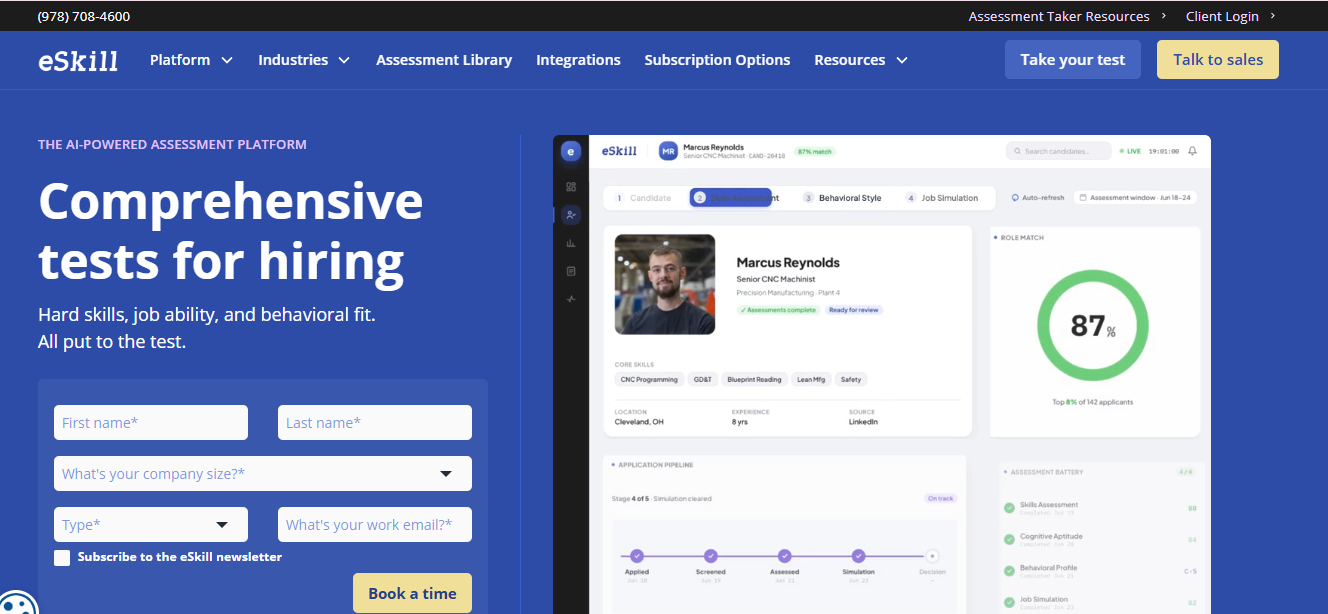
eSkill offers testing solutions that help organisations evaluate candidates for specific job requirements. Its assessments cover areas such as computer skills, software applications, aptitude, and other workplace competencies.
Recruiters can use the platform to create evaluations that reflect the skills needed for different positions.
Key Highlights:
- Job‑based skills assessments.
- Computer and software application tests.
- Custom assessment options.
- Candidate testing and reporting.
- Support for different job categories.
- Best for: Organisations hiring for administrative, operational, customer‑facing, and other role‑specific positions.
13. The Predictive Index
Best for: Behavioural and cognitive assessments
The Predictive Index provides behavioural and cognitive assessment solutions that help organisations understand how individuals approach work and solve problems.
Recruiters and managers can use these insights to support role alignment, team development, and talent decisions. The platform focuses on behavioural and cognitive information rather than serving as a broad technical testing library.
Key Highlights:
- Behavioural assessments.
- Cognitive ability evaluations.
- Workplace behaviour insights.
- Job and team analysis.
- Talent optimisation tools.
Best for: Organisations that want to understand candidate work styles and cognitive characteristics as part of recruitment.
14. Wonderlic
Best for: Cognitive ability and aptitude evaluation
Wonderlic is known for cognitive ability and personality‑related evaluations used in hiring and talent development. Its solutions help organisations gather information about reasoning, problem‑solving, and workplace characteristics.
These assessments can provide one additional source of information when recruiters are evaluating candidates for positions that require learning, reasoning, and decision‑making.
Key Highlights:
- Cognitive ability assessments.
- Personality‑related evaluations.
- Candidate assessment solutions.
- Hiring and talent development applications.
- Structured evaluation reports.
Best for: Employers that want to include cognitive and behavioural assessments in their hiring process.
15. Canditech
Best for: Job simulations and combined skills evaluation
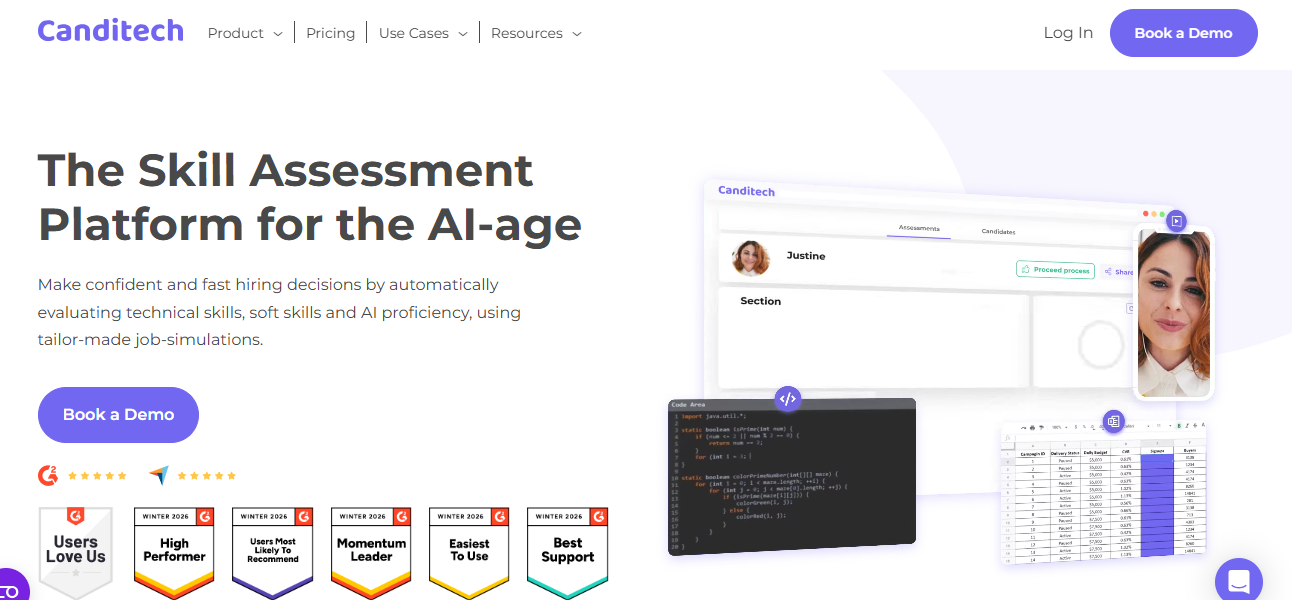
Canditech helps organisations evaluate candidates through practical assessments and job‑related exercises. Its approach is designed to help recruiters understand how applicants perform tasks connected to the position.
The platform supports different assessment formats, making it relevant to employers hiring for both technical and non‑technical roles.
Key Highlights:
- Job simulation assessments.
- Technical and business skills testing.
- Practical candidate evaluation.
- Custom assessment options.
- Candidate performance insights.
Best for: Organisations that want to evaluate candidates through realistic work‑related exercises.
16. Bryq
Best for: Cognitive and personality‑based candidate evaluation
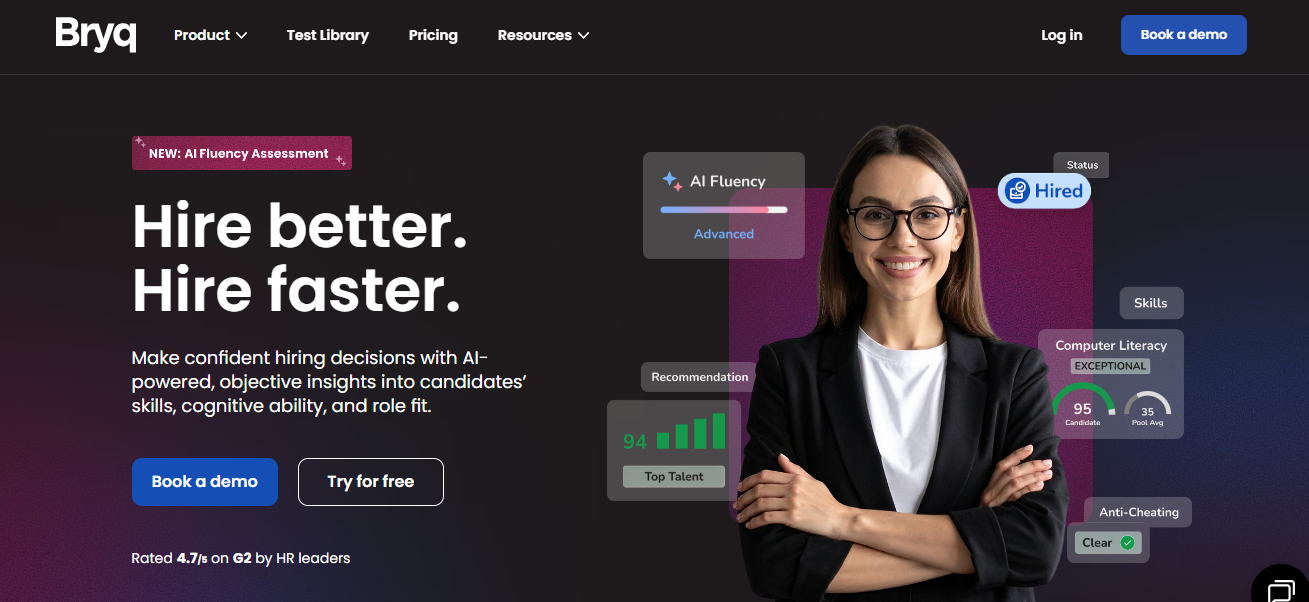
Bryq offers assessment solutions focused on cognitive ability, personality, and skills. It helps organisations gather structured information about candidates and compare their profiles with job‑related requirements.
Recruiters can use these insights as part of a broader selection process rather than relying only on resumes and interviews.
Key Highlights:
- Cognitive ability testing.
- Personality assessments.
- Skills evaluation.
- Candidate profiling.
- Recruitment‑focused reporting.
Best for: HR teams that want to include psychometric insights in their recruitment decisions.
17. Codility
Best for: Software engineering and coding assessments
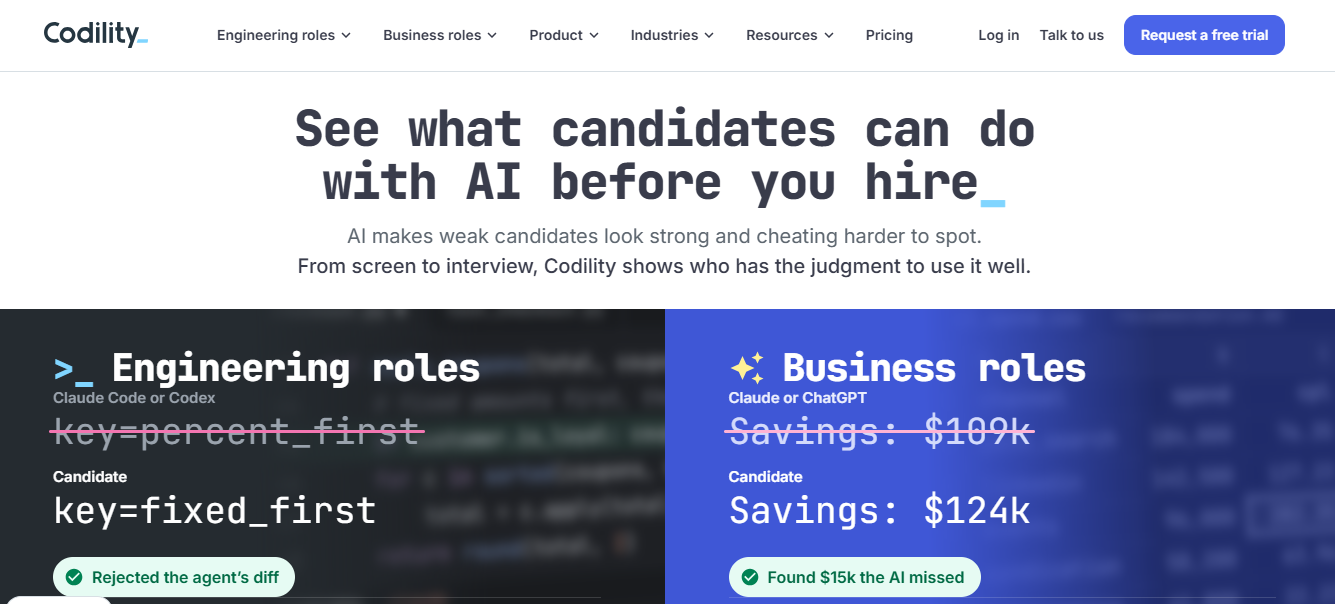
Codility is designed to help organisations evaluate software engineering candidates through practical coding tasks. Recruiters and technical interviewers can use coding assessments to understand programming knowledge and problem‑solving approaches.
It is particularly relevant for teams that need structured technical screening before conducting deeper engineering interviews.
Key Highlights:
- Coding and programming assessments.
- Technical skills evaluation.
- Practical coding tasks.
- Candidate performance insights.
- Technical recruitment workflows.
Best for: Engineering teams and technology companies hiring software developers.
18. CodeSignal
Best for: Technical skills evaluation and engineering recruitment
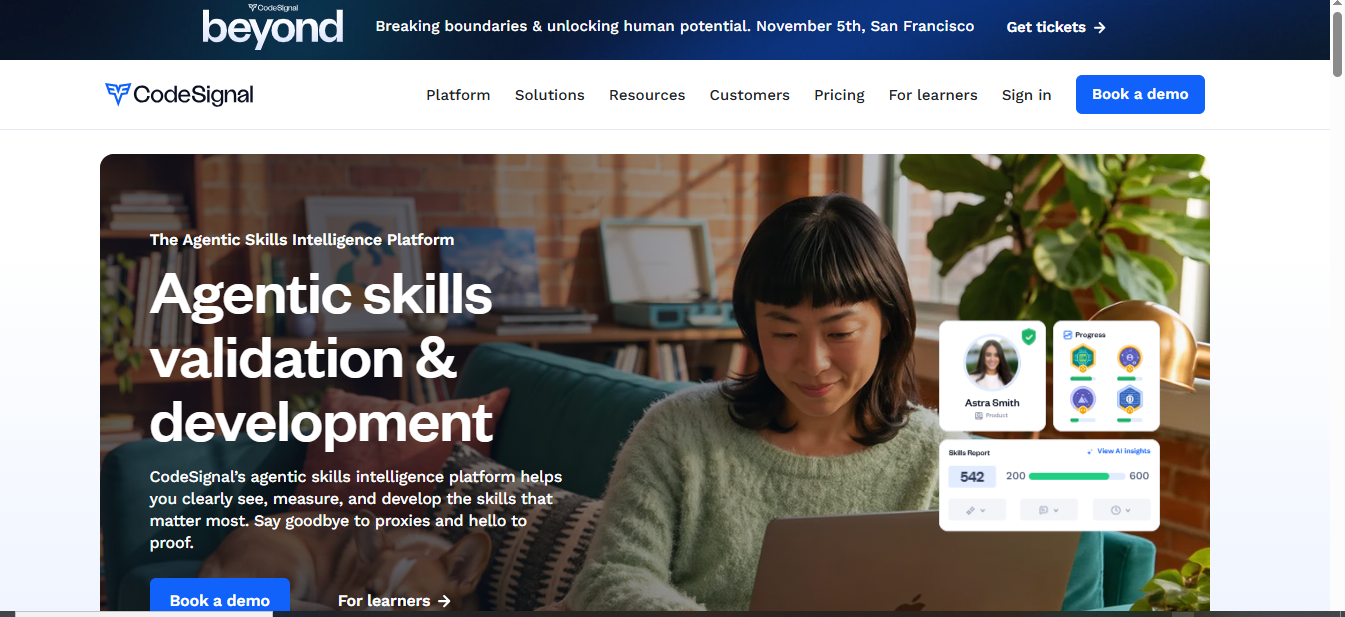
CodeSignal provides technical assessment and interview solutions for organisations hiring engineering talent. Its platform supports coding evaluations and other technical assessment workflows.
Hiring teams can use these tools to evaluate programming ability and gather consistent information about candidate performance.
Key Highlights:
- Technical and coding assessments.
- Programming skill evaluations.
- Technical interview capabilities.
- Candidate performance reporting.
- Recruitment workflow support.
Best for: Organisations that need structured technical evaluations for software engineering roles.
19. HackerEarth
Best for: Developer hiring, coding challenges, and technical screening
HackerEarth supports technical recruitment through coding tests, programming challenges, and developer evaluation tools. Its solutions can help organisations screen software developers and assess technical problem‑solving skills.
The platform also has developer‑focused engagement capabilities, which can be relevant to organisations running technical hiring programmes.
Key Highlights:
- Coding assessments and challenges.
- Technical screening.
- Programming skill evaluation.
- Candidate performance analytics.
- Developer hiring solutions.
Best for: Companies hiring software developers and conducting technical recruitment campaigns.
20. Harver
Best for: High‑volume and frontline recruitment
Harver provides recruitment solutions designed to support organisations hiring at scale. Its offerings include candidate assessments and hiring workflow capabilities that can help employers evaluate applicants for frontline and operational positions.
The platform is relevant to businesses that need to manage large candidate volumes while maintaining a structured selection process.
Key Highlights:
- Candidate assessment solutions.
- High‑volume recruitment support.
- Job‑related evaluations.
- Hiring workflow capabilities.
- Candidate screening tools.
Best for: Organisations hiring large numbers of candidates for customer service, retail, contact centre, and operational roles.
21. Aon Assessment Solutions
Best for: Psychometric testing and enterprise talent assessment
Aon Assessment Solutions offers assessment services and technology for organisations looking to evaluate candidates and employees. Its solutions include cognitive, behavioural, and skills‑related assessments.
Employers can use these evaluations to support recruitment, leadership assessment, and broader talent management activities.
Key Highlights:
- Cognitive ability testing.
- Personality and behavioural assessments.
- Skills and competency evaluation.
- Talent assessment solutions.
- Enterprise‑focused assessment services.
Best for: Large organisations that need structured assessment programmes across different roles and talent levels.
22. Talview
Best for: Online assessments, proctoring, and digital interviews
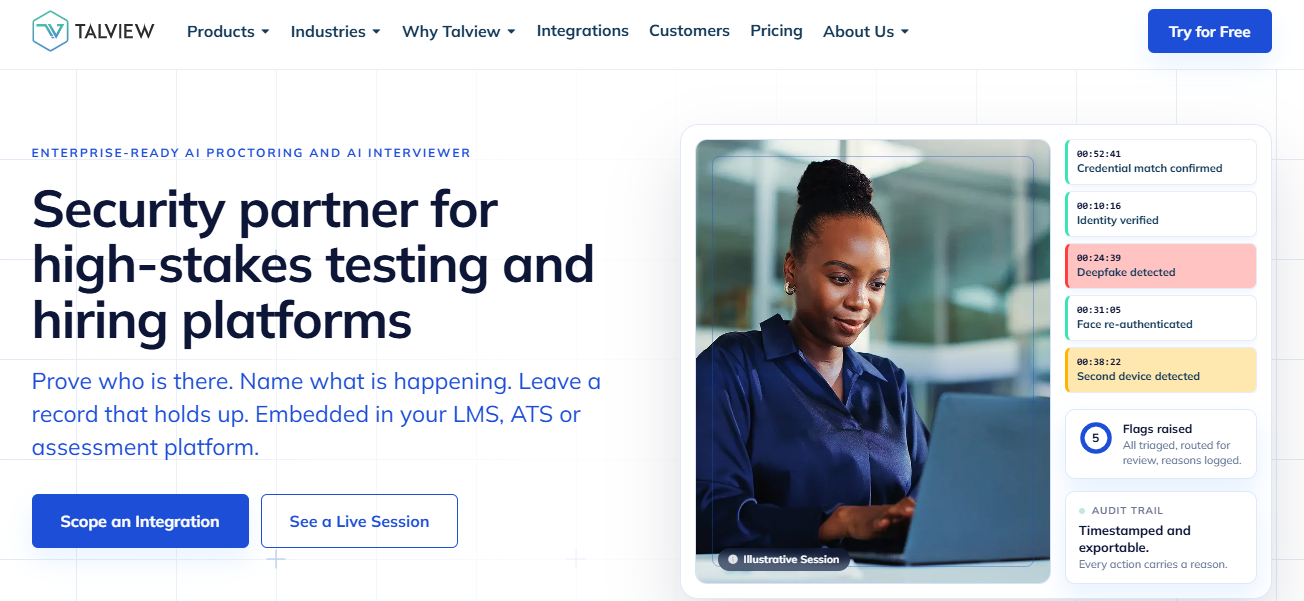
Talview provides solutions for digital assessments, interviews, and candidate evaluation. Its platform supports organisations that need to manage remote hiring and assessment activities.
Proctoring and identity‑related capabilities can help employers establish assessment conditions and monitor test sessions, depending on the configuration used.
Key Highlights:
- Online assessments.
- Remote proctoring capabilities.
- Digital interviewing.
- Candidate evaluation workflows.
- Enterprise assessment support.
Best for: Organisations conducting remote assessments and digital recruitment at scale.
23. Adaface
Best for: Conversational technical and non‑technical skills tests
Adaface offers skills tests designed to help recruiters evaluate candidates across technical and non‑technical job requirements. Its assessment approach uses conversational‑style questions alongside other testing formats.
Recruiters can select relevant tests to screen applicants for different positions and review their performance before progressing candidates.
Key Highlights:
- Technical skills assessments.
- Non‑technical and aptitude tests.
- Conversational assessment format.
- Role‑based test options.
- Candidate reporting.
Best for: Recruitment teams that want skills‑based screening across different job categories.
24. Alooba
Best for: Data, analytics, and technical skills assessment
Alooba focuses on evaluating technical and data‑related capabilities. Its assessments can help organisations screen candidates for positions involving data analysis, programming, and related technical skills.
The platform is especially relevant to hiring teams that need to understand a candidate's practical ability in data‑focused roles.
Key Highlights:
- Data and analytics assessments.
- Technical skills testing.
- Practical evaluation formats.
- Candidate performance reporting.
- Assessment options for data‑related roles.
Best for: Companies hiring data analysts, data scientists, and other technical professionals.
Key Features to Look for in a Pre‑Employment Assessment Platform
Selecting a Pre‑Employment Assessment platform involves more than comparing the number of tests available. Recruiters should consider how well the product fits their roles, candidate journey, hiring volume, and existing recruitment systems.
1. Technical and Non‑Technical Test Coverage
Choose a platform that supports the skills required by your open positions. Technical teams may need coding and programming tests, while sales, customer support, HR, and operations teams may need communication, aptitude, situational judgement, or role‑specific assessments.
2. Custom Assessment Creation
Pre‑built tests can save time, but recruiters may also need to create questions based on specific job requirements. Look for tools that allow hiring teams to customise questions, skills, difficulty levels, and assessment duration.
3. Automated Scoring and Reports
Automated scoring can reduce manual evaluation work. Reports should make it easy to understand candidate performance, identify strengths, and compare results against relevant criteria.
4. Proctoring and Assessment Integrity
For remote testing, recruiters may want features such as identity verification, tab‑switch monitoring, multiple‑face detection, copy‑and‑paste restrictions, or other controls. The exact availability of these features varies across providers.
5. Candidate Database and Pipeline Management
Assessment results are more useful when they are connected to the wider recruitment workflow. Candidate management features can help HR teams organise applicants, track assessment status, and manage progress through hiring stages.
6. Integrations and Collaboration
Check whether the platform connects with your applicant tracking system and other HR tools. Team collaboration features can also help recruiters and hiring managers review candidate results together.
Choosing a Pre‑Employment Assessment solution with these capabilities can help recruiters build a more structured evaluation process and manage candidate assessments efficiently.
How to Choose the Right Pre‑Employment Assessment Platform
Not every organisation needs the same evaluation process. The right choice depends on the positions being filled, the number of applicants, the skills being measured, and the way the recruitment team works.
Consider the following factors before making a decision:
Selection factor | What recruiters should evaluate |
Hiring requirements | Does the platform support the roles and skills you recruit for? |
Assessment types | Does it offer technical, aptitude, behavioural, and role‑specific tests where needed? |
Customisation | Can you create or modify tests for your job requirements? |
Candidate experience | Is the assessment easy to access and complete? |
Reporting | Can recruiters understand and compare candidate results? |
Security | Are appropriate assessment integrity and proctoring options available? |
Integrations | Does it work with your existing recruitment systems? |
Scalability | Can it support your expected candidate volume? |
Pricing | Does the cost match your assessment volume and required features? |
Choose Based on Your Hiring Requirements
- For software engineering: Consider HackerRank, Codility, CodeSignal, and HackerEarth.
- For general skills testing: Consider TestGorilla, Testlify, Criteria, and Mercer Mettl.
- For cognitive and behavioural evaluation: Consider SHL, Wonderlic, Bryq, and The Predictive Index.
- For practical job simulations: Consider Vervoe and Canditech.
- For high‑volume hiring: Consider Harver, HireVue, and Talview.
- For data and analytics roles: Consider Alooba and iMocha.
- Before finalising a provider, request a demonstration, test the candidate experience, review sample reports, and confirm current pricing and integration requirements.
Why Consider Talent31 for Pre‑Employment Assessment?
Recruiters often use separate tools for sourcing, screening, assessments, and candidate management. Managing these activities across disconnected systems can make it harder to maintain a consistent hiring workflow.
Talent31 brings several recruitment capabilities together, supporting candidate discovery, assessment, and management.
AI‑Powered Candidate Matching
Recruiters can define the skills and requirements for a position. Talent31 uses AI‑powered matching to help identify candidates whose profiles are relevant to those requirements.
Candidate Database Management
Recruitment teams can import and organise their existing candidate records. This helps them manage applicants and use their candidate database as part of the recruitment workflow.
Technical and Non‑Technical Assessments
Talent31 supports assessments for both technical and non‑technical skills. This allows recruiters to evaluate applicants for different job categories instead of relying on a single type of test.
AI‑Led Conversational Interviews
The platform supports AI‑led conversational interviews that can evaluate candidate responses. This provides another evaluation stage for recruiters to consider alongside assessment results and other hiring information.
Assessment Proctoring
Talent31 includes assessment integrity features such as multiple‑face detection, tab‑switch restrictions, copy‑and‑paste restrictions, multiple‑display restrictions, and IP tracking.
Candidate Pipeline Management
Recruiters can manage candidate progress and assessment activity through the recruitment workflow, helping teams keep candidate information organised.
For organisations looking to combine candidate matching, skills evaluation, and candidate management, Talent31 is worth exploring.
Conclusion: Choosing the Right Pre‑Employment Assessment Platform
Choosing the right assessment solution can help recruitment teams evaluate candidates more consistently and make better‑informed hiring decisions. However, no single platform is the right fit for every organisation. The best choice depends on the roles being filled, the skills being evaluated, hiring volume, and the recruitment workflow.
From technical testing tools such as HackerRank and Codility to broader platforms such as TestGorilla, Mercer Mettl, and Talent31, recruiters have several options to consider.
A well‑designed Pre‑Employment Assessment process should focus on relevant skills, clear evaluation criteria, a positive candidate experience, and responsible use of assessment results. By comparing platform capabilities against actual hiring requirements, organisations can build a more structured and effective recruitment process.
If your team wants to bring AI‑powered candidate matching, technical and non‑technical assessments, and candidate management into one workflow, explore Talent31.
Frequently Asked Questions
1. What is a Pre‑Employment Assessment?
A Pre‑Employment Assessment is a test or evaluation used by employers to measure a candidate's job‑related skills, knowledge, abilities, or behavioural characteristics before making a hiring decision. It may include technical tests, aptitude questions, personality evaluations, situational judgement tests, or practical tasks.
2. Why do recruiters use online assessment software?
Recruiters use online assessment software to evaluate candidates in a structured way. It can help reduce repetitive manual screening, support consistent evaluation, and provide additional information about applicants before interviews.
3. Which platform is best for technical hiring?
The right platform depends on the programming languages, technical skills, and evaluation methods required. HackerRank, Codility, CodeSignal, HackerEarth, and iMocha are options worth comparing for technical recruitment.
4. Can assessment platforms evaluate non‑technical candidates?
Yes. Many platforms support evaluations for communication, aptitude, personality, situational judgement, customer service, sales, and other non‑technical competencies. Recruiters should confirm that the available tests match the specific role.
5. What is the difference between skills tests and psychometric assessments?
Skills tests measure a candidate's ability to perform specific tasks or demonstrate particular knowledge. Psychometric assessments generally measure characteristics such as cognitive ability, personality, and behavioural preferences. Both can provide useful information, but they measure different things.
6. What is assessment proctoring?
Assessment proctoring refers to tools and processes used to monitor or secure an online test. Depending on the platform, this may include identity checks, webcam monitoring, browser activity controls, tab‑switch detection, and other integrity measures.
7. How should recruiters select the right assessment platform?
Recruiters should consider the roles they hire for, test formats, customisation, reporting, candidate experience, security, integrations, scalability, and pricing. A trial or product demonstration can help confirm whether a platform meets the organisation's needs.
8. Can assessments replace interviews?
No. Assessments should support the recruitment process, not replace every interview or human decision. Recruiters should consider test results alongside candidate experience, work history, interviews, and other job‑related evidence.