
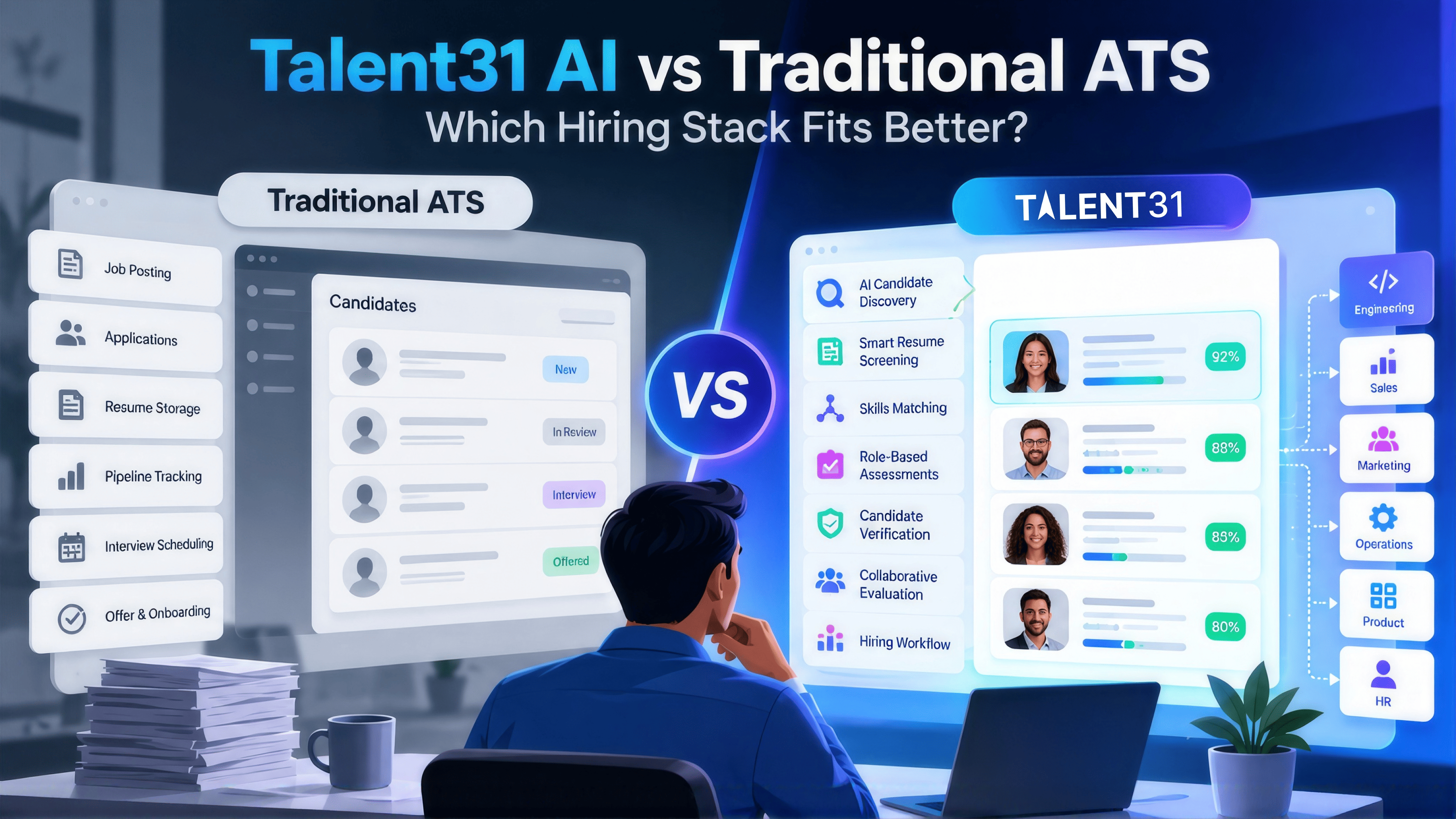
A lot of hiring teams think they have a sourcing problem when the real issue is evaluation. The ATS has every applicant in it, but that does not mean the team can tell who can actually do the work. It is a bit like having a logistics system that tracks every package while never checking what is inside the box.
That is the core of the Talent31 AI vs ATS decision. Are you trying to manage candidate flow, or are you trying to discover, assess, verify, and compare talent in a more evidence‑based way? Those are related problems, but they are not the same. And if your stack is built for the wrong one, the process feels busy while the hiring outcome stays uneven.
The answer isn't always replacing your ATS. In many organizations, the better question is whether the ATS should remain the system of record while an AI‑powered platform handles discovery, skills evaluation, and candidate comparison.
The world before a skills‑first recruitment workflow
Most teams do not start with a clean slate. They start with fragmented tools and a crowded process.
Recruiters search one place for applications, source passive candidates somewhere else, screen resumes manually or with keyword filters, send assessments through another tool, and then ask hiring managers to make sense of scattered notes. Remote hiring adds another layer because identity and assessment integrity become harder to trust.
That creates a hidden cost in a recruitment workflow:
- Search cost from reviewing the wrong profiles
- Screening cost from high applicant volume
- Evaluation cost from repeated ad hoc assessments
- Coordination cost from switching between tools
- Decision cost from inconsistent evidence
- Integrity cost from remote assessment concerns
- Candidate‑experience cost from slow, duplicated steps
This is where skills assessment matters. A resume tells you what a person claims. A good evaluation process tells you something closer to what they can actually do.
What a traditional ATS does well
A traditional ATS is the control plane for applicant flow. It manages requisitions, applications, candidate status, communications, interview coordination, offers, reporting, and sometimes onboarding. It is built to answer operational questions like Who applied? What stage are they in? What is the next action? Has the offer gone out?
That makes an ATS valuable for:
- Centralized requisition management
- Candidate record storage
- Stage tracking
- Recruiter task ownership
- Automated communications
- Career‑site and job‑board workflows
- Funnel reporting
- Process consistency
In other words, an ATS is strong at process control. These capabilities are not typically the primary focus of a traditional ATS and may require additional tools or workflows, depending on the platform.
What changes with a skills‑first AI platform?
A skills‑first platform starts from a different premise. Instead of asking only who applied, it asks who matches the role, what they can do, and how well that evidence holds up.
That is the logic behind Talent31 AI. Talent31's platform includes AI‑powered candidate discovery, semantic matching, resume screening, role‑based assessment, verification, reporting, and collaboration in one workflow. The product is designed for technical and non‑technical hiring, not just one talent lane.
The practical shift is simple:
- Define the role
- Discover relevant candidates
- Match by skills and context
- Assess capability
- Verify participation
- Compare evidence
- Move to interview
- Hire with more structure
That is a different kind of skills assessment stack. It does not replace human judgment. It gives hiring teams better inputs before judgment is needed.
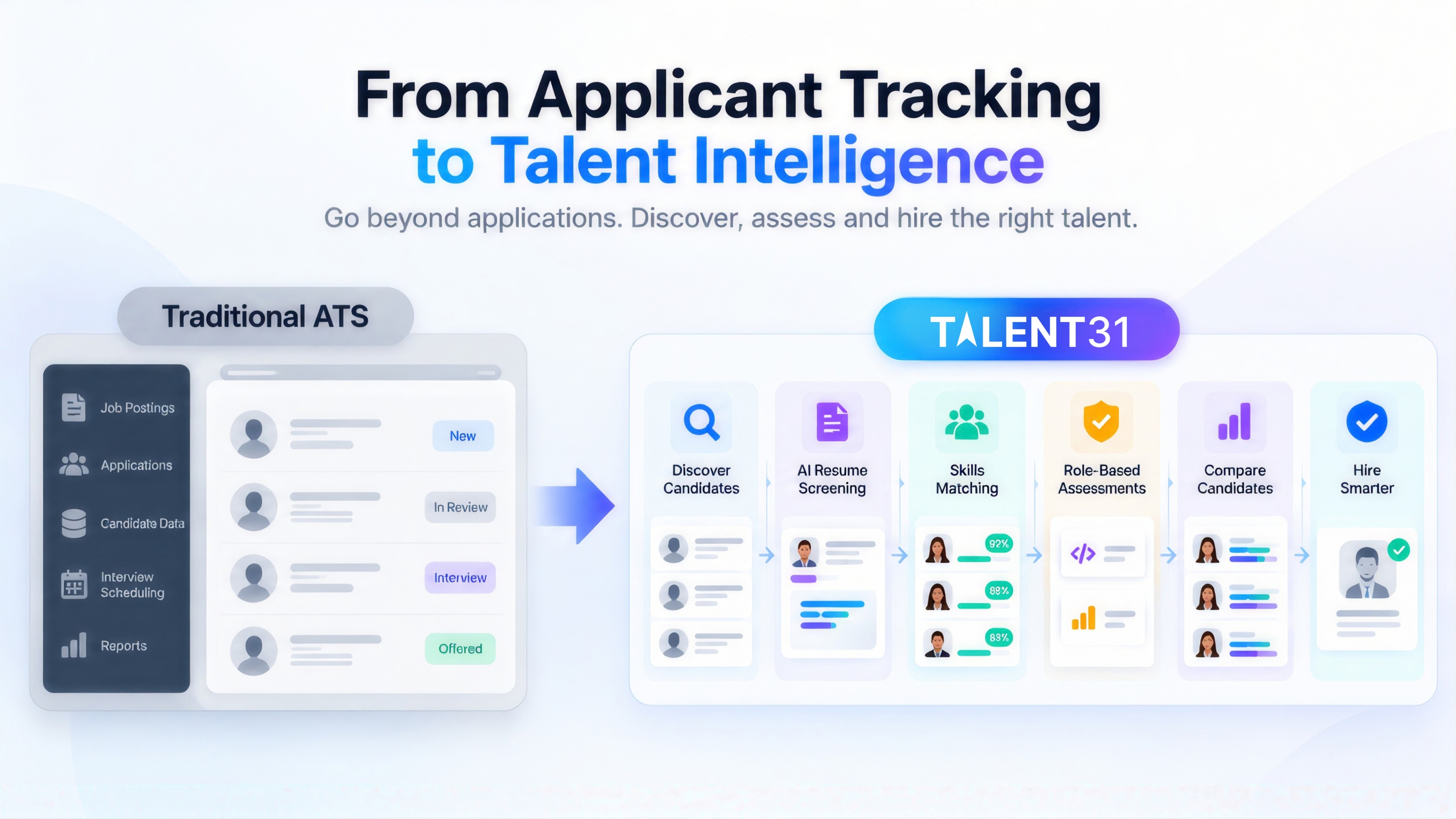
Talent31 AI vs ATS: the stage‑by‑stage difference
Hiring stage | Traditional ATS‑centered stack | Talent31 AI | What This Means for Hiring Teams |
Role definition | Stores requisitions, approvals, and job details | Uses role requirements and competencies as inputs for discovery and assessment | ATS manages the requisition; Talent31 turns requirements into evaluation criteria. |
Sourcing | Captures applicants and may support job‑board workflows | Adds global talent discovery, conversational search, and AI‑assisted matching | Talent31 is stronger when the problem is finding relevant talent, not just processing applicants. |
Resume screening | Stores and parses resumes; may use screening questions | Extracts skills, experience, and technologies and ranks candidates | Talent31 emphasizes contextual fit and skills evidence. |
Technical assessment | Often depends on a separate tool or manual process | Supports technical, non‑technical, role‑based, and multi‑skill assessments | Talent31 reduces handoffs between discovery and evaluation. |
Verification | Usually handled outside the ATS | Supports identity verification and assessment‑integrity monitoring | Adds integrity signals to remote assessments |
Candidate comparison | Usually based on resume, status, and interview notes | Combines profile, skill results, and assessment reports | Gives a richer comparison model |
Pipeline management | Core ATS function | Supports candidate pipeline management and workflow | ATS remains the system of record in many environments. |
Collaboration | Notes, approvals, and feedback vary by system. | Shareable reports and team collaboration are built in. | Talent31 centers shared evidence, not only shared status. |
Final decision | The human team decides from ATS records and interviews. | The human team retains control while AI supports the workflow. | Talent31 is decision support, not autonomous hiring. |
The point is not that one tool is “better” in every sense. It is that they are optimized for different problems.
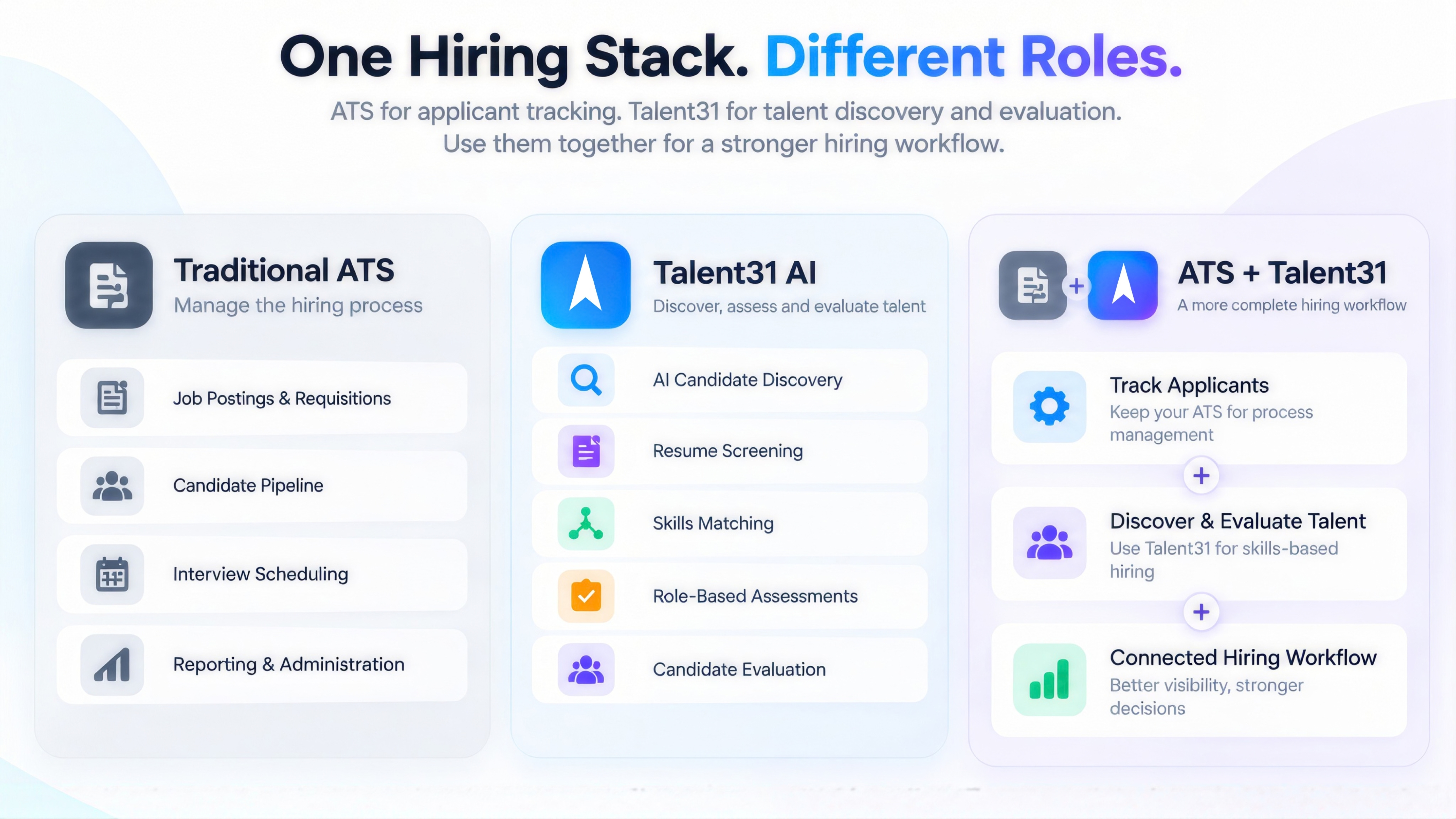
Talent31 AI vs ATS vs ATS + Talent31
Approach | Best suited for |
Traditional ATS | Applicant tracking and recruiting administration |
Talent31 AI | Skills‑focused discovery, assessment, and candidate evaluation |
ATS + Talent31 | Organizations that want to retain their ATS while strengthening sourcing and evaluation |
When Should You Keep Your ATS and Add an AI Recruitment Platform?
The best answer for many teams is not replacement. It is augmentation.
Keep the ATS when it already owns requisitions, applications, compliance records, offers, and broader HR workflows. Add Talent31 when the real pain is sourcing, screening, assessment, or remote verification.
That usually makes sense when:
- Recruiters are buried in volume
- Technical roles are hard to fill
- Hiring managers want more consistent evidence
- Assessment results live in disconnected tools
- Remote proctoring matters
- The ATS is deeply embedded and hard to replace
- The organization can confirm a workable integration or operating process
This is where the Talent31 AI vs ATS decision gets practical. If your ATS is the backbone of the business, keep it. Then use Talent31 to solve the evaluation gap.
When a broader Talent31‑centered workflow makes more sense
A Talent31‑Centered Workflow may make sense when the organization needs a more unified path from discovery to evaluation and does not rely on a heavy ATS for enterprise administration.
That is often true for:
- Startups and scale‑ups
- Staffing firms and RPOs
- Smaller or faster‑moving hiring teams
- Groups hiring across technical and non‑technical roles
- Teams that need structured skills assessment without stitching together multiple tools
Talent31 is especially relevant when the hiring problem is not “How do we track applicants?” but “How do we find the right people and assess them well enough to make a better call?”
Where Talent31 stands out in real use
A few examples make the difference easier to see.
High‑volume engineering hiring
A team gets flooded with software‑engineering applications. The ATS can collect them, but recruiters still need a way to identify who has the right technologies and problem‑solving ability. Talent31 helps the team discover relevant candidates, run role‑specific assessments, review skill‑wise results, and prioritize interviews.
Specialized AI and machine‑learning hiring
A role calls for Python, machine learning, LLM experience, or generative AI work. Keywords alone will not tell you who has meaningful depth. Talent31 supports conversational search, AI matching, and targeted assessment so the team can compare candidates on evidence, not just claims.
Remote technical hiring
For distributed teams, identity verification and monitoring matter. Talent31’s proctoring layer provides assessment‑integrity signals such as identity verification, multiple‑face detection, multiple‑display detection, tab‑switching detection, copy/paste monitoring, screen monitoring, and audit trails. That is not perfect assurance, but it is better than blind trust.
Multi‑department hiring
A company hiring across sales, customer support, operations, finance, or high‑volume non‑technical hiring may need to assess different competencies without creating a completely separate hiring workflow for every department.
Governance still matters
Any AI hiring tool needs guardrails. Talent31 can speed up discovery and evaluation, but it should not be treated as a black box.
Buyers should ask:
- What data is used for matching and ranking?
- Can humans review and override recommendations?
- What data is collected during proctoring?
- How long is it retained?
- How are false positives reviewed?
- What accommodations are available?
- Can the organization export scores and audit data?
- How does the vendor handle bias testing and model changes?
That is especially important because Talent31 AI vs ATS is not only a feature comparison. It is also a decision about process ownership, candidate data, and trust.
FAQ
Is Talent31 an ATS?
Talent31 is an AI‑powered recruitment, talent intelligence, and skills assessment platform. It includes candidate workflow features, but buyers should verify whether it covers every ATS administration need they rely on.
Can Talent31 replace our existing ATS?
Not universally. If you depend on your ATS for requisitions, applications, communications, offers, and compliance records, you may want to keep it and add Talent31 for sourcing and evaluation.
What is the main difference between Talent31 AI and a traditional ATS?
A traditional ATS primarily manages applicant flow. Talent31 focuses on discovering relevant candidates, matching skills to role requirements, assessing capability, and helping teams compare evidence.
Does AI matching remove bias?
No. AI can reproduce bias if the underlying data or criteria are flawed.
Does Talent31 prevent cheating in online assessments?
It supports assessment‑integrity monitoring and identity verification, but that does not mean cheating can be eliminated completely. Flags still require human review.
Is skills assessment better than resume screening?
They answer different questions. Resume screening shows claimed experience. Skills assessment provides additional evidence about capability. The strongest hiring process uses both.
What roles can Talent31 support?
It is designed for technical and non‑technical hiring, including engineering, AI/ML, sales, support, operations, product, finance, and other functions.
Conclusion
The smartest hiring stack is not the one with the most modules. It is the one that matches the real bottleneck.
If the bottleneck is finding specialized talent, evaluating skills, and comparing candidates with structured evidence, an AI recruitment platform such as Talent31 may address capabilities that aren't the primary focus of a traditional ATS. In many organizations, the answer isn't either‑or: the ATS can remain the system of record while Talent31 strengthens discovery, assessment, and candidate evaluation.
That is the more mature architecture. And over time, that is the kind of hiring stack that tends to move faster without becoming looser.